

Summarize this article with AI Open a summary of this article in your preferred assistant
Artificial grass is made by extruding polyethylene or polypropylene into yarn, tufting the yarn into a backing fabric, coating the back with latex or polyurethane to lock the tufts, then inspecting and rolling the carpet. On site it is laid on a drained base, joined and usually filled with sand and a performance infill.
Artificial grass is made in four main steps: plastic granules are melted and extruded into yarn, the yarn is tufted into a backing fabric, the back of the carpet is coated to lock the tufts, and the finished carpet is inspected and rolled. On site it becomes a turf system once it is laid on a prepared base, joined and, for most sports turf, filled with sand and a performance infill.
How is the yarn made?
Production starts with polymer granules, usually polyethylene for soft sports and landscape yarns and polypropylene for some short, hard-wearing piles. The granules are mixed with colour masterbatch and additives that help the yarn resist ultraviolet light. The mix is melted and pushed through a die, a process called extrusion.
For monofilament yarn, the die has small openings with a set cross-section, such as a flat, a spine or an omega profile. The filaments are cooled, stretched to give them strength and wound onto bobbins, often several filaments together as one yarn. For fibrillated yarn, a wide film is extruded and slit into a tape that splits into a net-like structure. Curled or texturised yarns are crimped after extrusion so that they stay low and springy.
Yarn weight is given in dtex, the mass in grams of 10,000 metres of yarn. As an example, the Pro Odin Grass data sheet lists a PE monofilament, spine profile, 1.4 mm wide, at 12,000 dtex, 6 filaments per tuft.
What happens on the tufting machine?
A tufting machine works like a very wide sewing machine. Hundreds of needles push the yarn through a primary backing fabric, and hooks underneath hold each loop so that it forms a tuft. The distance between needle rows is called the gauge, and the number of stitches per length sets how dense the carpet is.
Pile height, gauge and stitch rate are chosen for the end use. A football carpet has long tufts spaced to hold infill, a landscape carpet has a dense pile that stands up on its own, and a padel or tennis carpet has a short pile that gives a true ball bounce.
How is the backing coated and finished?
After tufting, the tufts are only held by friction. A back coating of latex or polyurethane is spread on the underside and cured in a drying oven, which bonds each tuft to the backing. How strongly a tuft is held is called tuft withdrawal force, and it is one of the values laboratories test.
Most coated carpets are then perforated with small holes so that water drains vertically. The carpet is trimmed, checked for missing stitches and colour faults, cut to roll length and labelled with its production batch. The table summarises the stages.
| Stage | What happens | What a buyer can specify |
|---|---|---|
| Compounding | Polymer, colour and UV additives are mixed | Colour, yarn polymer |
| Extrusion | Yarn is formed, stretched and wound | Yarn profile, width, dtex, filaments per tuft |
| Tufting | Yarn is stitched into the primary backing | Pile height, gauge, stitch rate |
| Coating | Latex or polyurethane locks the tufts | Backing type, drainage perforation |
| Finishing | Inspection, cutting, rolling, labelling | Roll width and length, line colours |
How does the carpet become a sports surface?
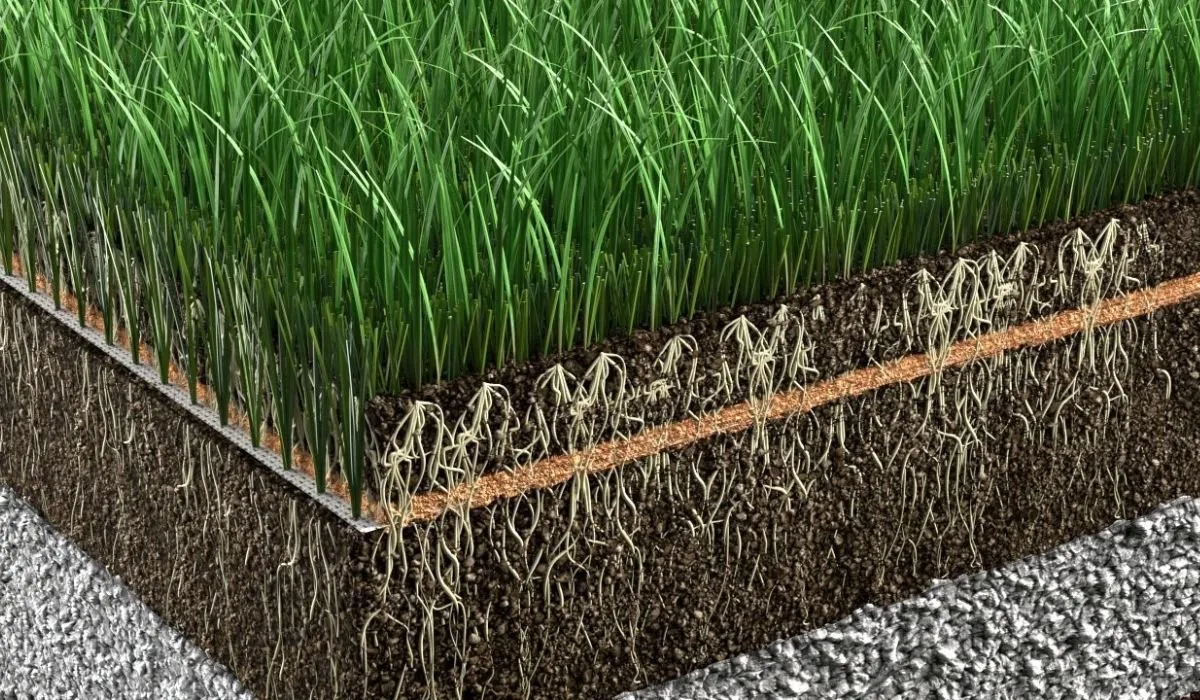
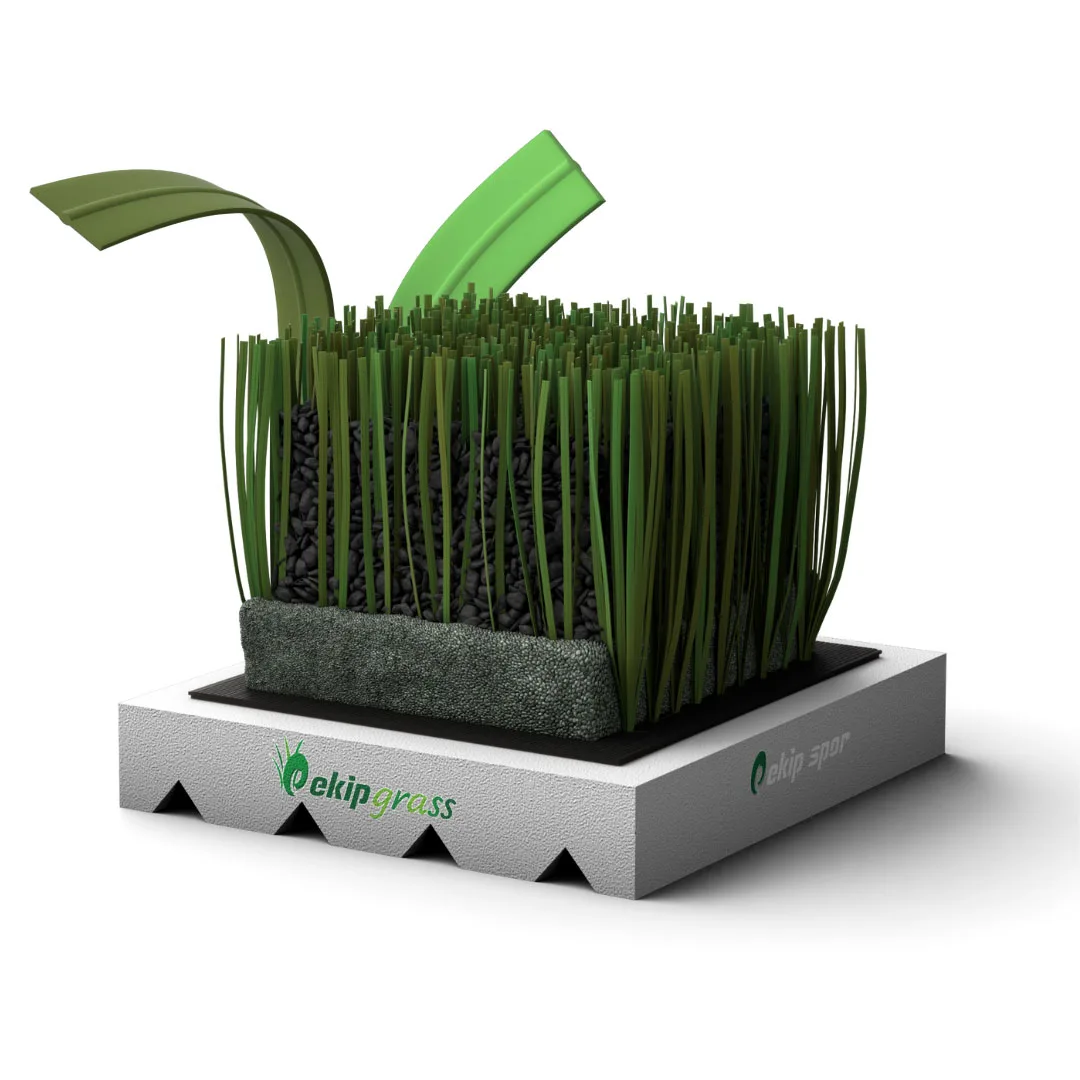
A roll of artificial grass is one part of a system. For a football pitch, the ground is excavated, drainage is laid and a compacted base of crushed stone is levelled to falls. Some designs add a shock pad on top of the base.
The rolls are laid side by side, joined with seaming tape and adhesive, and line markings are cut in or tufted in. Sand is then spread and brushed down to weigh the carpet, followed by a performance infill such as rubber granules or an organic material. FIFA notes that it was third-generation (3G) systems, which include both sand and rubber infill, that made turf a true alternative for football.
Landscape grass is simpler. It is usually laid on compacted granular base or a sound hard surface with drainage, joined, fixed at the edges and brushed, often with little or no infill. The steps for gardens are covered in how to install artificial grass.
How are the finished systems tested?
Laboratories test yarn, carpet and complete systems against standards. In Europe, EN 15330-1 sets requirements for synthetic turf surfaces mainly for outdoor use, including football. For football turf, the FIFA Quality Programme tests a full system in the laboratory and then tests each installed pitch on site, so a product passing laboratory tests is not the same as a certified pitch.
Where is Ekip Grass made?
Ekip Grass carpets are made at the Ekip Spor factory in Dilovası, Kocaeli, Türkiye. The company holds a TSE certificate for TS EN 15330-1 football turf and is a licensee of the FIFA Quality Programme for Football Turf; see the certificates and FIFA Quality pages for the documents and the pitch register data.
Frequently asked questions
What is artificial grass yarn made of?
Most yarn is polyethylene, which is soft and suited to sports and landscape turf. Polypropylene is used for some short, hard-wearing piles.
What does dtex mean for artificial grass?
Dtex is the weight in grams of 10,000 metres of yarn. A higher dtex means a heavier yarn, but it says nothing on its own about pile height or density.
Why is artificial grass backing perforated?
The latex or polyurethane coating would hold water on top of the carpet, so most backings are perforated to let rain drain down into the base.
Is a roll of artificial grass a finished sports pitch?
No. The carpet becomes a pitch only after it is laid on a drained base, joined, marked and, for most football turf, filled with sand and infill, and then tested on site where a standard requires it.
0 comments
Leave a comment
Your comment will be published after review.