
Summarize this article with AI Open a summary of this article in your preferred assistant
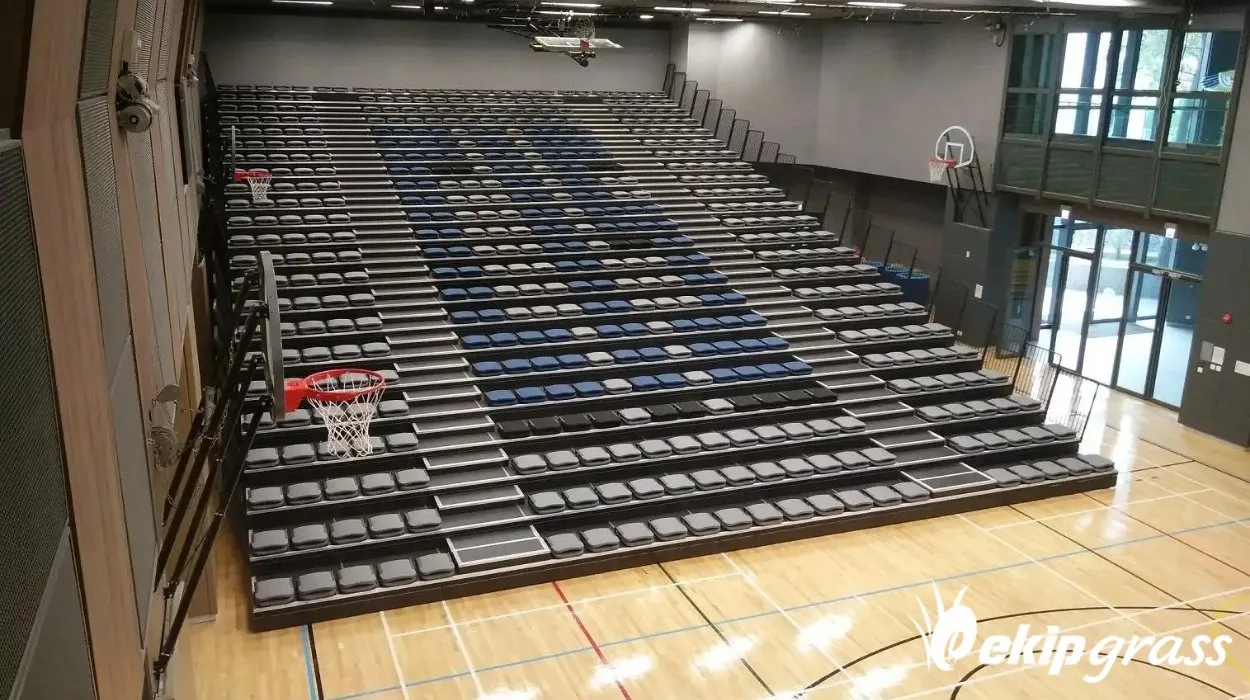
A telescopic grandstand, also called a telescopic tribune or retractable seating, is a stand whose rows slide into each other so it folds into a compact block against a wall. It frees floor space in sports halls and multi-purpose venues. In Europe, EN 13200-5 specifies product characteristics for telescopic stands.
A telescopic grandstand, also called a telescopic tribune or retractable seating, is a stand whose rows slide into each other so it folds into a compact block against a wall when not in use. Extended, it gives tiered seating for spectators; retracted, it frees the floor for training, events or other sports. In Europe, the standard EN 13200-5 specifies product characteristics for telescopic stands.
How does a telescopic grandstand work?
Each row is a deck mounted on its own steel frame with wheels or rollers. The rows are nested: the lowest row sits at the front and the highest at the back. When the stand is opened, the front row is pulled out first and each row follows to its stop, forming a stepped seating bank.
Opening and closing may be manual for small units or motorised for larger ones. Seats are fixed, folding or flip-up, so the decks can close over each other. When closed, the stand forms a block that is only as deep as one row plus the frames.
Where are telescopic grandstands used?
- Sports halls and school gyms, where the floor is used for training most of the time and seating is needed only for matches.
- Multi-purpose venues and conference centres that switch between flat-floor events and seated audiences.
- Theatres, auditoriums and studios that need a flexible seating layout.
- University halls used for graduations, exams and sports.
The common thread is a room that changes use during the week. If a hall hosts spectators only a few times a year, a demountable stand may be enough; if seating is needed every weekend, a telescopic unit avoids repeated assembly. The comparison below sets out the main differences.
How do telescopic, fixed and demountable stands compare?
| Type | Floor space when not in use | Typical setting | Points to weigh |
|---|---|---|---|
| Telescopic stand | Folds to a compact block against a wall | Indoor halls, auditoriums | Needs a level, load-bearing floor and trained staff to operate |
| Fixed stand | Permanently occupied | Stadiums, arenas with fixed seating | No flexibility; part of the building structure |
| Demountable stand | Removed after the event | Temporary events, outdoor tournaments | Assembly and dismantling each time; storage space |
Which standard applies?
EN 13200-5, "Spectator facilities - Part 5: Telescopic stands", is listed as valid from 6 October 2006 in the Estonian Centre for Standardisation catalogue. Its published scope states that it specifies product characteristics for telescopic stands at permanent or temporary entertainment venues, including sports stadiums, sport halls and indoor and outdoor facilities, and that stands in fairgrounds and amusement parks are excluded.
Building, fire and accessibility codes in the country of installation also apply. These usually govern escape routes, aisle widths, guardrails and wheelchair spaces, so involve the building designer early.
What should you plan before ordering?
- Space when open and closed: measure the depth the stand needs when extended, the clear floor in front of it, and the wall space it needs when closed.
- Floor: the stand rolls and stands on the hall floor, so the floor and the subfloor must carry the loads the manufacturer specifies. Ask how the wheels and supports will affect the sports surface.
- Rows and sightlines: the number of rows and the rise between them decide whether spectators in the back can see the near touchline or court edge.
- Access and exits: aisle positions, stairs, handrails and wheelchair spaces follow local codes.
- Operation: decide whether the stand will be manual or motorised and who will be trained to open and close it.
- Documentation: ask for the declaration or test evidence against EN 13200-5 and the local building rules, plus the operating and inspection manual.
How is a telescopic stand maintained?
Moving parts wear, so regular checks are part of safe use. Typical items are wheels and guides, locking mechanisms that hold each row when extended, guardrails, seat fixings and, for motorised units, the drive and safety stops. Follow the manufacturer's inspection interval and keep a log. Never use a stand that is only partly extended unless the manufacturer allows it.
Telescopic grandstands from Ekip Spor
Ekip Spor, the company behind the Ekip Grass brand, manufactures and installs telescopic grandstands; see our grandstand construction service. Because Ekip also installs PVC indoor sports flooring with its own teams, the stand and the hall floor can be planned as one project, with the floor loads and the wheel tracks of the stand agreed before installation. For a proposal, send the hall plan, the number of seats or rows you need, and whether the stand should be manual or motorised through the contact page.
Choosing the hall floor
If you are also choosing a surface, see our guide to PVC sports flooring and the indoor sports flooring and multi-purpose flooring pages.
Frequently asked questions
What is a telescopic grandstand?
It is a retractable seating stand whose rows slide into each other, so it can be pulled out for spectators and folded into a compact block against a wall when the floor is needed.
Where are telescopic grandstands used?
They are used in sports halls, school gyms, multi-purpose venues, auditoriums and university halls, where the floor is used for different activities and seating is needed only part of the time.
Is there a standard for telescopic stands?
Yes. EN 13200-5 specifies product characteristics for telescopic stands at permanent or temporary entertainment venues. Local building, fire and accessibility codes also apply.
Can a telescopic stand be installed on any floor?
Only on a floor that can carry the loads the manufacturer specifies. The effect of the wheels and supports on the sports surface should also be checked before installation.
Does Ekip make telescopic grandstands?
Yes. Ekip Spor manufactures and installs telescopic grandstands, and it can plan the stand together with the indoor sports floor of the hall.

0 comments
Leave a comment
Your comment will be published after review.