
Indoor Sports Flooring
We supply and install floors for sports halls, school gyms, futsal courts and indoor training areas: PVC sports flooring, poured polyurethane and synthetic turf. The right floor depends on which sports the hall hosts and what else it is used for. Cushioning, grip and ball bounce affect both performance and the load on players' joints.
- EN 14904European standard for indoor multi-sport surfaces
- 3 floor typesPVC · polyurethane · turf
- Subfloor firstDry, level, clean slab
Short answer
School hall, court sport or futsal: the right floor
- School and multi-use halls: a PVC or polyurethane floor with moderate cushioning gives a reliable bounce and is easy to clean.
- Court sports halls: PVC sports flooring with foam backing, welded at the seams, in plain colours or wood-effect prints.
- Futsal and football training: a short-pile indoor turf with little or no infill to limit dust.
Floor types
PVC, poured polyurethane or indoor turf
PVC sports floor
PVC sports flooring comes in rolls with a foam backing and is welded at the seams. It is used for basketball, volleyball, handball, futsal and badminton halls, in plain colours and wood-effect prints.
Thickness and backing type set how much cushioning it gives.
Poured polyurethane
A jointless polyurethane floor laid in place, sometimes over a prefabricated rubber layer. It suits multi-sport halls and fitness areas and is easy to clean.
Indoor turf
Synthetic turf is used indoors for football training, five-a-side and futsal centres and athletic warm-up areas. Indoor turf usually has a shorter pile and little or no infill, to limit dust and maintenance. Our Non-Infill Grass needs no rubber granules.
Side by side
Indoor floors compared
| PVC sports floor | Poured polyurethane | Indoor turf | |
|---|---|---|---|
| Seams | Welded | None | Seamed and glued |
| Typical sports | Basketball, volleyball, handball, badminton | Multi-sport, fitness | Futsal, football training |
| Elasticity | Point-elastic | Point-elastic | Depends on pile and pad |
| Cleaning | Sweep, damp-clean | Sweep, damp-clean | Brush, vacuum |
| Events and furniture | With covers | With covers | Not suited |
Limits
Where a PVC sports floor reaches its limits
Sport England's UK design guidance note Floors for Indoor Sports (2007) sets out what vinyl sheet floors do well and where they stop. These four limits are the ones to check against the timetable of your hall.
| Limit | What it means in a hall |
|---|---|
| The slab shows through | A sheet floor without a foam backing or supporting system relies on the slab beneath it, and any irregularity can show on the surface. The guidance also asks for a damp-proof membrane and a slab below 75 % relative humidity, or the figure the flooring maker requires. |
| Elasticity | Foam-backed sheet floors are point-elastic or mixed-elastic in EN 14904 terms. Table tennis is the clearest case where that is the wrong choice: the guidance does not recommend point-elastic or mixed-elastic floors for it, because the stability of the table depends on the floor deforming as little as possible. |
| Sports that need a stiff surface | The soft feel of a foam backing suits barefoot activities, floor work and young children, but it can limit sports such as roller skating that need a stiff surface without drag. |
| End of life | A vinyl floor has to be disposed of when it is worn out. The guidance names this, together with the cleaning regime, as a lifecycle point to settle at design stage. |
From our range
Non-Infill Grass and Multi Sport Grass for indoor training
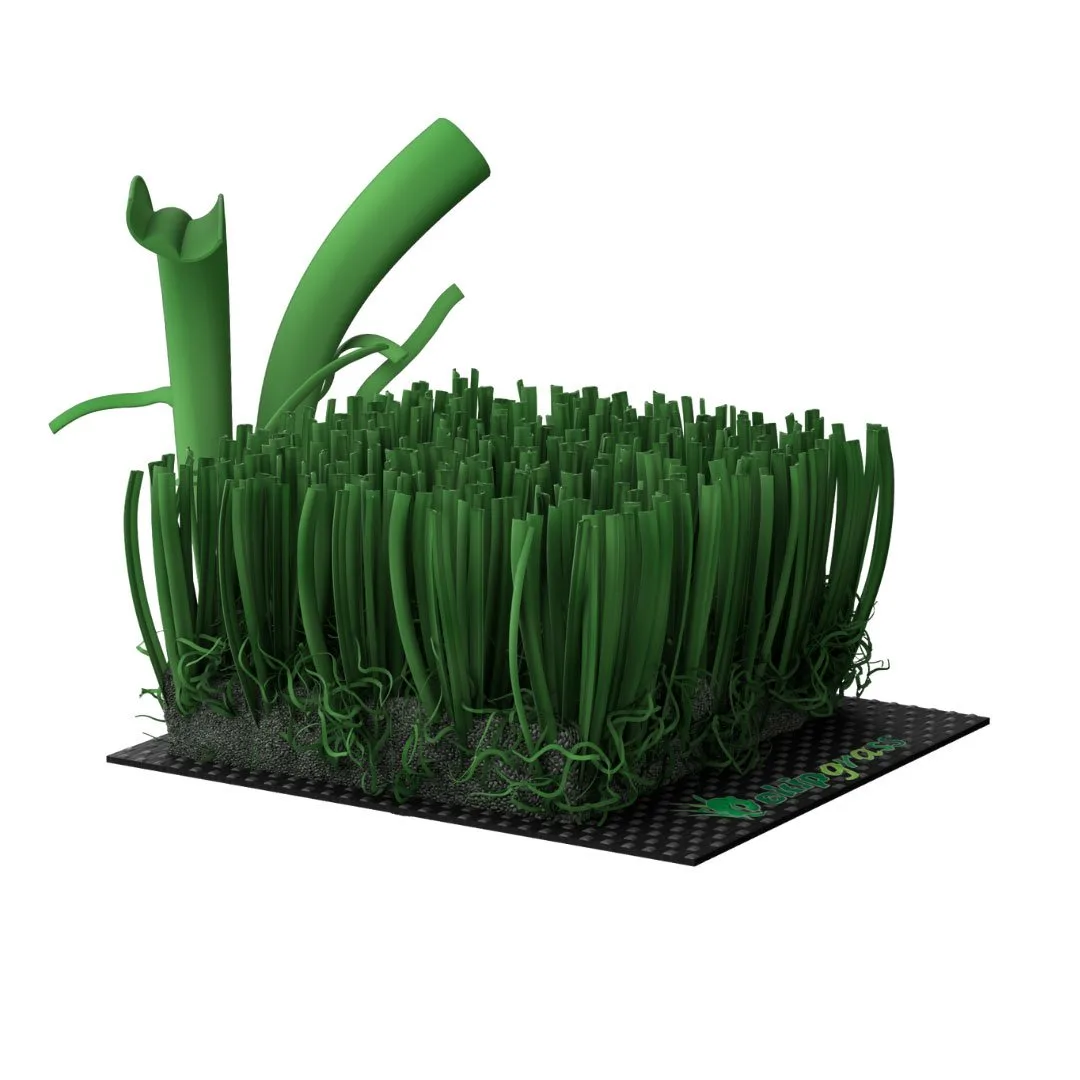
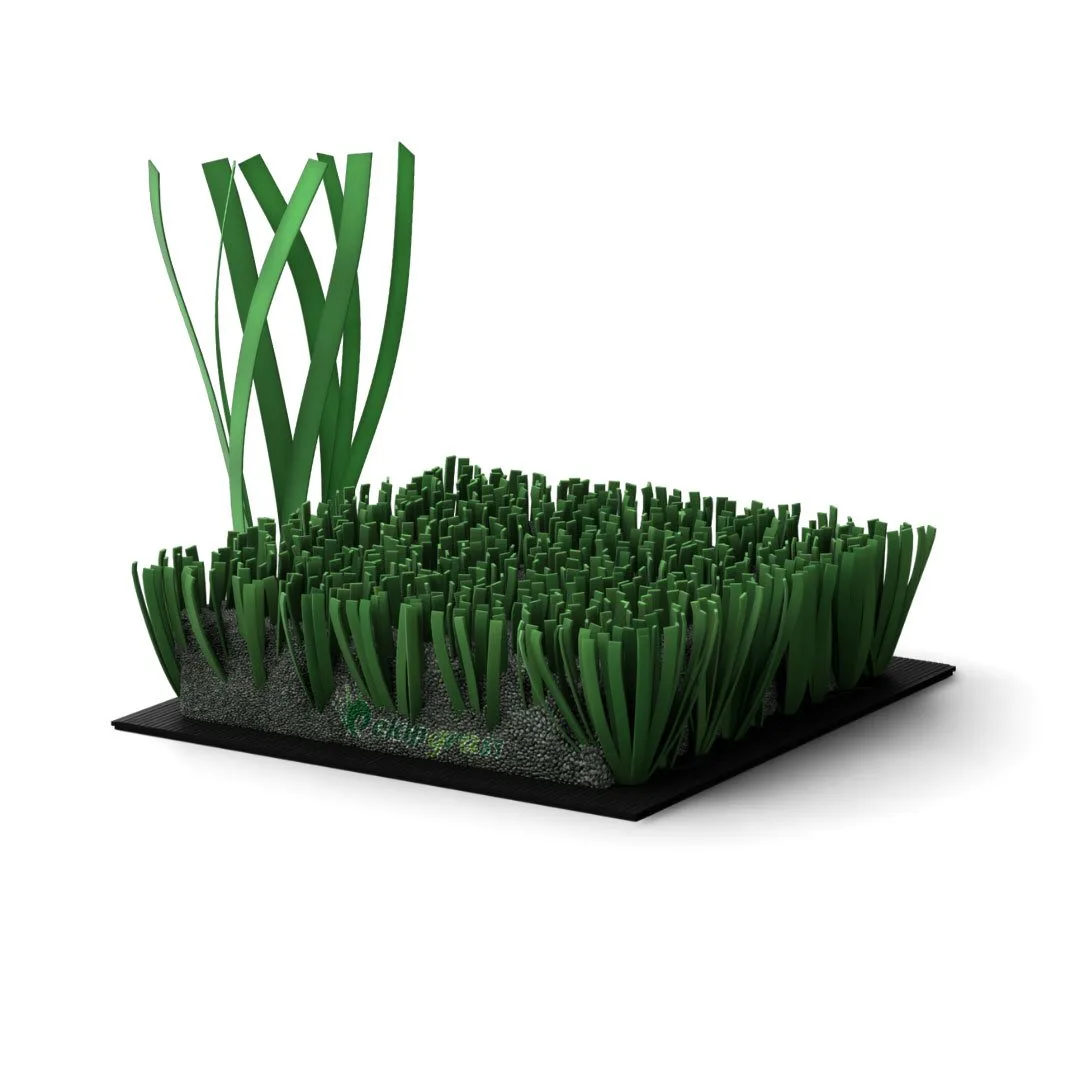
Turf data
Non-Infill Grass and Multi Sport Grass side by side
In Non-Infill Grass, straight and curled yarns are tufted together, and the curled yarn fills the base of the pile. That is why the turf needs no rubber granules, only a small amount of silica sand. Multi Sport Grass has a lower pile and comes in seven colours, which suits halls with colour-coded zones. The full technical lines are on the Non-Infill Grass and Multi Sport Grass product pages.
| Non-Infill Grass | Multi Sport Grass | |
|---|---|---|
| Pile height | 30–35 mm | 13–30 mm; 35 mm for small-sided pitches |
| Yarn decitex | 16,000 dtex | 5,500 dtex |
| Colours | Lime green or dark green; mixed or zebra on request | Green, dark green, red, terracotta, yellow, blue, white |
| Use | Football pitches, landscaping | Multi-purpose courts, small-sided football, landscaping |
| Made in | Dilovası, Kocaeli, Türkiye | Dilovası, Kocaeli, Türkiye |
Standards
EN 14904 and building rules
In Europe, EN 14904 sets test methods and limits for indoor surfaces used for multi-sports: shock absorption (force reduction), vertical deformation, ball rebound, slip resistance, rolling load and wear. Floors are also described as point-elastic, area-elastic or combined, depending on how they flex under a player. The test report has to cover the exact product and thickness offered.
Sports halls are public buildings, so local regulations usually require a reaction-to-fire classification for the floor covering, given under EN 13501-1. Check it against your building permit.
- Force reductionHow much impact the floor absorbs.
- Vertical deformationHow far it gives under a player.
- Ball reboundHow the ball bounces compared with concrete.
- Friction and wearGrip for turning, and durability.
Planning
Court sizes in a hall
A hall floor is usually laid wall to wall, with the courts marked in separate colours. These are the playing areas of the common indoor sports, before safety zones.
| Handball, futsal | 40 × 20 m |
|---|---|
| Basketball (FIBA) | 28 × 15 m |
| Volleyball | 18 × 9 m |
| Badminton, doubles | 13.40 × 6.10 m |
| Floor area | Wall to wall |
From slab to first game
Slab check, preparation and fitting the floor
Slab check
Moisture, flatness and condition of the concrete are tested on site.
Preparation
Cracks, old adhesive and paint are removed; uneven slabs get a levelling compound.
Floor
PVC is laid and welded, polyurethane poured, or turf seamed.
Lines
Court lines are marked in a colour for each sport.
Handover
You receive the cleaning plan and guidance on covers for events.
Maintenance
Hall floor care
Daily
Use entrance mats to stop grit coming in on shoes. Sweep or vacuum and damp-clean with products recommended for the floor type.
Events
Protect the floor with covers and load spreaders when the hall is used for non-sport events. Indoor turf needs regular brushing and vacuuming.
Other sports
Surfaces for other sports
Questions
School halls, test reports and subfloors
Which floor is best for a school sports hall?
A school hall usually hosts many sports plus assemblies and events, so a PVC or polyurethane floor with moderate cushioning is a common choice. It gives a reliable ball bounce for basketball and volleyball, tolerates furniture with protection and is easy to clean. If the hall is mainly for football, an indoor turf may suit better.
What does EN 14904 cover?
EN 14904 is the European standard for indoor multi-sport surfaces. It sets test methods and limits for shock absorption (force reduction), vertical deformation, ball rebound, slip resistance, rolling load and wear. Tenders in Europe often require a floor tested to EN 14904. The test report has to cover the exact product and thickness being offered.
Can the floor go directly on our concrete slab?
Usually, if the slab is dry, flat and sound. New concrete needs time to dry before installation, and moisture is tested on site. Uneven slabs need a levelling compound first. Cracks, old adhesive and paint must be removed. We check the slab before confirming the floor build, since most indoor floor failures start at the subfloor.
How do we maintain an indoor sports floor?
Entrance mats stop grit coming in on shoes. Sweep or vacuum the floor daily. Some cleaners leave a slippery film, so damp-clean only with products recommended for the floor type. When the hall hosts events, protect the floor with covers and load spreaders. Indoor turf needs regular brushing and vacuuming.
What should we send for a quote?
Send the hall dimensions, the sports played and any non-sport uses, the type and age of the subfloor, and photos of the current floor. Mention any tender requirements such as EN 14904 or a fire classification. Tell us if line markings, wall protection or equipment such as goals and basketball hoops should be included.
Hall size, sports and subfloor: what to send us
Send us the hall size, the sports and the subfloor. We reply with the floor build and a quote.
- Hall dimensions
- Sports and other uses
- Subfloor type and age
- EN 14904 or fire class in the tender
- Lines and equipment
Related guides
-
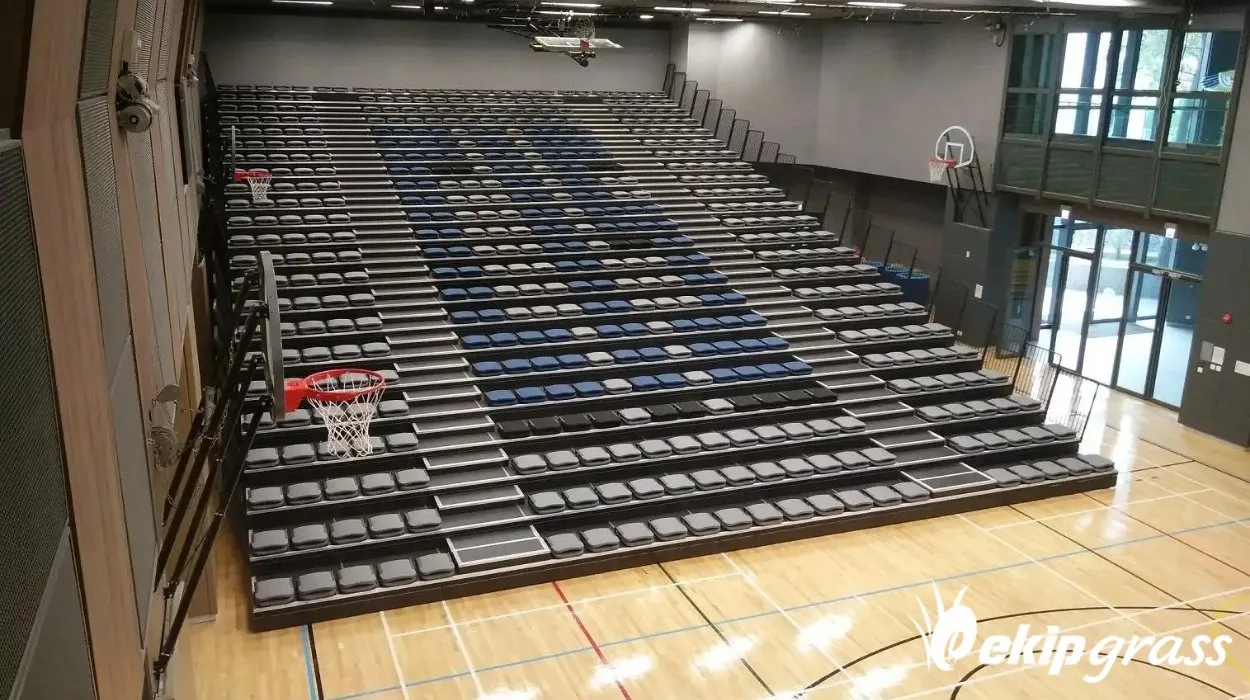
Telescopic Grandstands: How Retractable Seating Works and What to Plan
A telescopic grandstand is retractable seating whose rows slide into one another so the stand folds against a wall when not in use. This guide… Read the guide -

What Is PVC Sports Flooring? Construction, Uses and Installation
PVC sports flooring is a vinyl surface laid in rolls over a level subfloor in sports halls, school gyms and multi-use rooms. This guide explains its… Read the guide -

Football Pitch Surface Types: Natural, Hybrid and Artificial
Football is played on natural grass, hybrid grass and artificial turf, plus hard courts for informal games. This guide explains each surface, what the… Read the guide