
Summarize this article with AI Open a summary of this article in your preferred assistant
An artificial grass football pitch lets a school use one field for lessons, breaks and after-school clubs through most of the year, because it does not need rest periods to recover. Planning one means choosing sizes that fit the age groups, a turf system suited to heavy daily use, a safe run-off area, and a maintenance routine the school can follow.
An artificial grass football pitch lets a school use the same field for PE lessons, breaks and after-school clubs through most of the year. Natural grass needs rest to recover and turns to mud in wet months, while artificial turf can take use day after day if it is maintained. Planning a school pitch comes down to four decisions: the size and markings, the turf system, the surroundings and the maintenance routine.
Why do schools choose artificial grass pitches?
The main reason is available playing time. A grass field that closes after rain, or that has to be rested between matches, limits the timetable. An artificial surface drains through its base and does not need mowing, fertilising or reseeding, so lessons can be planned with fewer cancellations.
A second reason is flexibility. One surface can carry line markings for several pitch sizes, so younger and older pupils can use the same area in different layouts. Artificial turf still needs care, though: brushing, debris removal and infill top-up are part of owning one.
What size should a school pitch be?
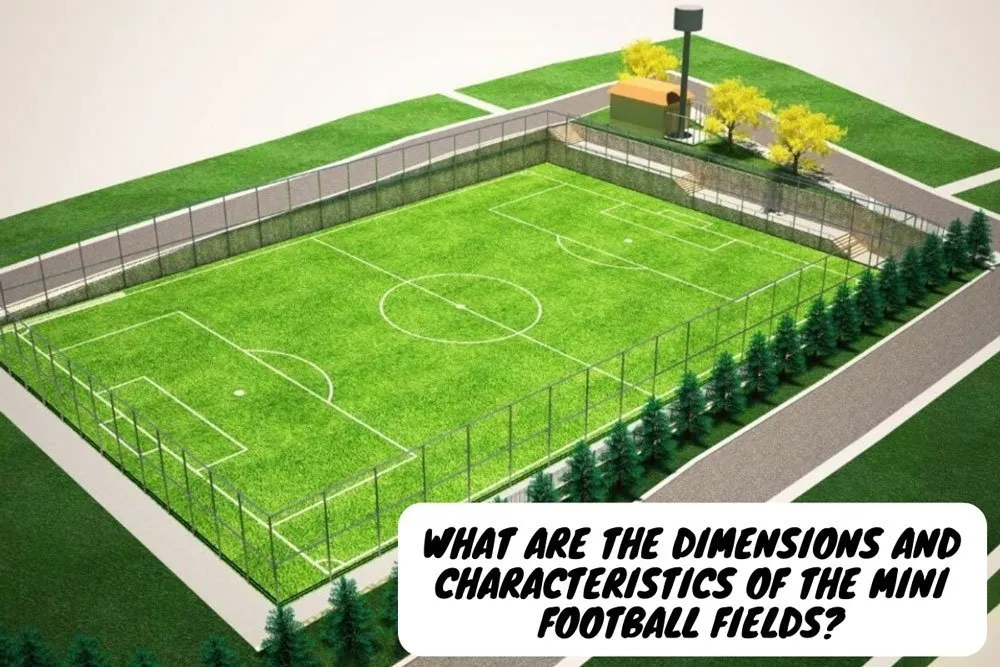
There is no single global size for youth pitches. Each national association publishes its own recommendations. The English FA, in Section 38 of The FA Handbook 2025-26, recommends a maximum of 40 x 30 yards for 5v5 play at under-7 and under-8 level, 60 x 40 yards for 7v7 at under-9 and under-10, and 80 x 50 yards for 9v9 at under-11 and under-12, each without run-off.
The same FA guidance suggests colour-coded lines when several pitches share one surface: red for 5v5, yellow for 7v7, blue for 9v9 and white for 11v11. A secondary school can therefore mark one full pitch and smaller cross-pitches on the same turf. Our guide to mini football pitch dimensions lists the formats in more detail.
Which turf system suits a school?
School pitches see many hours of mixed use, often in ordinary trainers rather than football boots. The turf system should be chosen for that load, and for the sports the school plans to play.
| System type | Example product data | Typical school use | Maintenance points |
|---|---|---|---|
| Infilled football turf | Odin Grass: pile height 20–65 mm; 40–60 mm recommended for football | Main football pitch, club use after school | Regular brushing, infill levels at goalmouths |
| Non-infill turf | Non-Infill Grass: pile height 30–35 mm; no rubber granules, a small amount of silica sand | Small-sided football where rubber infill is not wanted | Brushing, debris removal |
| Multi-sport turf | Multi Sport Grass: pile height 13–30 mm; 35 mm for small-sided pitches | Multi-purpose courts, small-sided football | Brushing, line checks |
Some public buyers set their own rules on infill material, so check the tender documents before choosing an infill type.
What about safety around the pitch?
Leave a clear run-off area around the playing lines. The FA recommends a run-off of at least 3 yards (or 3 metres) all around natural grass pitches, and says that football turf used as run-off should be built to the same performance standards as the pitch and be green. Keep fences, benches and lighting poles outside this area.
Goals must be secured so that they cannot tip over, and ball-stop fencing protects windows and neighbours. If the school wants evidence that the installed surface performs as specified, it can ask for field testing. Under the FIFA Quality Programme for Football Turf, the FIFA QUALITY mark is awarded to pitches that meet the standard for community and amateur pitches, after laboratory testing of the product and testing of the final installation.
How should a school maintain the pitch?
Name one person responsible for the pitch and keep a simple log. Typical tasks are brushing to keep the pile upright, removing leaves and litter, checking infill depth in high-wear areas such as goalmouths, and inspecting seams and lines. The installer's manual should set the frequency, which depends on how many hours the pitch is used.
Food, chewing gum and sharp objects damage the surface faster than play does, so clear rules for pupils help. For routine cleaning steps, see how to clean artificial grass.
School pitches from Ekip Grass
Ekip Grass manufactures football and multi-sport turf in Dilovası, Kocaeli, Türkiye, and is a licensee of the FIFA Quality Programme for Football Turf. Its quality and product certificates are listed on the certificates page, and school projects can be discussed through the contact page.

0 comments
Leave a comment
Your comment will be published after review.