
Cricket Pitches and Outfield Turf
Ekip Grass supplies short-pile synthetic surfaces for cricket match strips, practice net lanes and outfields, and can build the base beneath them. An artificial pitch lets clubs and schools play and train on days when a natural turf wicket cannot be prepared. Ball bounce depends mostly on the base and the shock pad, so they are specified together with the carpet.
- 22 yd20.12 m between the stumps
- 3 surfacesMatch strip · nets · outfield
- Firm baseConcrete or bound macadam
Short answer
Which cricket surface do you need?
- Matches on a club or school square: a non-turf match strip on a firm, level base with a shock pad.
- Training volume: practice net lanes in the same short-pile surface, with durable run-ups.
- Dry climates and multi-sport grounds: an infilled synthetic outfield, chosen to slow the ball enough for fielding.
Surface types
Strip, nets or outfield
Match strip
A non-turf match pitch is a strip laid in the middle of the square. It is made longer and wider than the 22-yard pitch, so the bowler's landing area and the batter's crease are both on the same surface.
The carpet is very short and dense, either tufted or needle-punched, over a shock pad on concrete or bound macadam. A loose aggregate base is not used under a strip, because it gives uneven bounce.
Practice nets
Net lanes take far more balls per square metre than a match strip, especially in the bowlers' landing zones. They use the same short-pile surface and firm base.
The run-ups need a durable surface that does not slip under bowling spikes, and the landing zones are checked more often for wear.
Outfield
Synthetic outfields are less common, but they are used on multi-sport grounds, at schools and in dry climates where irrigation is limited.
They use an infilled turf similar to football turf, with a pile chosen to slow the ball enough for fielding. Our Dogu Grass is made in piles from 20 to 65 mm.
Side by side
Cricket surfaces compared
| Match strip | Practice nets | Synthetic outfield | |
|---|---|---|---|
| Carpet | Very short, dense | Very short, dense | Infilled turf |
| Base | Concrete or bound macadam + shock pad | Firm, level base + shock pad | Permeable base |
| Main demand | Even bounce end to end | Wear in landing zones | Ball speed for fielding |
| After rain | Sweep or squeegee, then play | Sweep, check run-ups | Drains through |
| Typical user | Clubs, schools | Clubs, academies | Multi-sport grounds, dry climates |
From our range
Turf from our range for cricket grounds

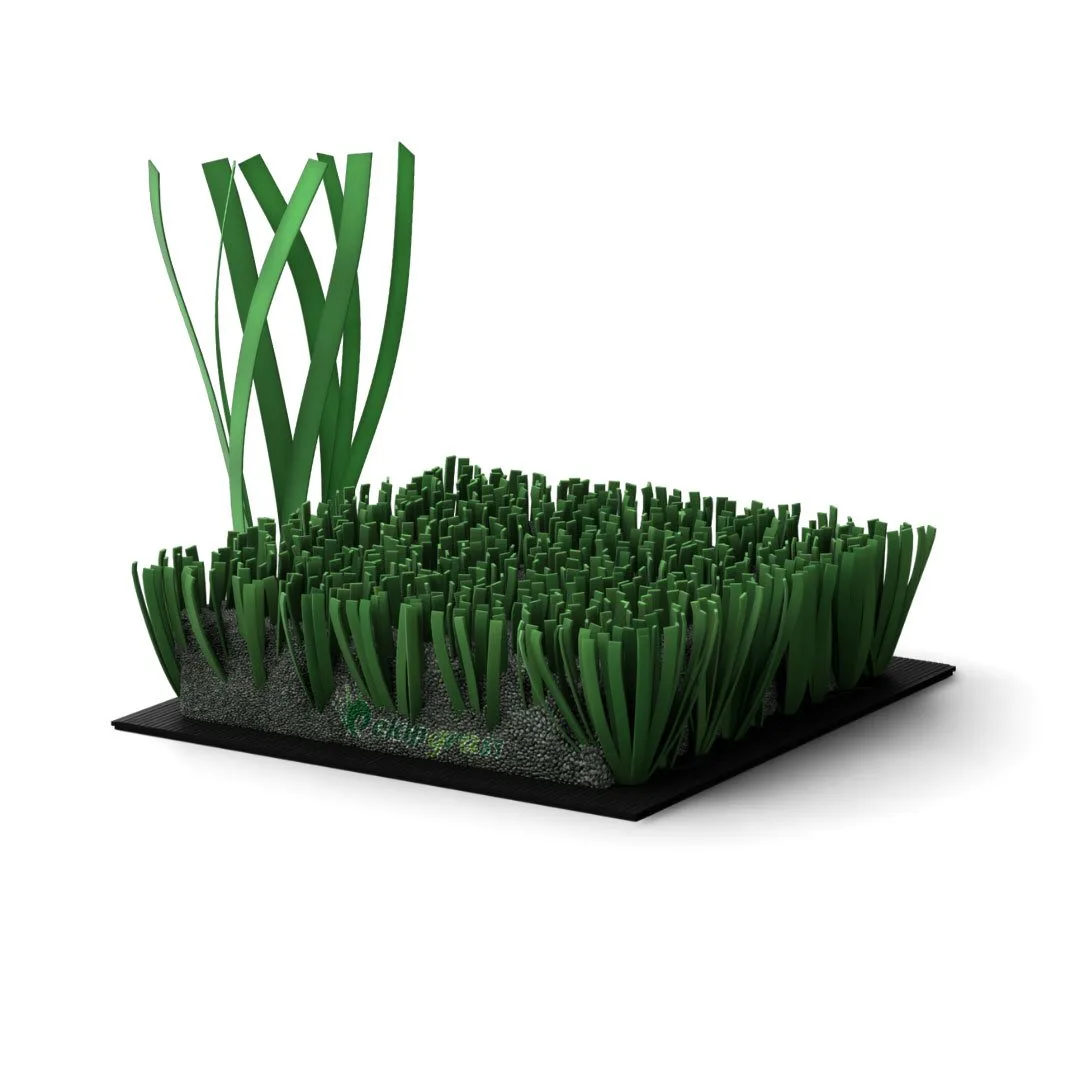
Performance
How a non-turf pitch plays
A non-turf pitch gives a more even bounce from end to end and changes less during a match, because it does not wear or crack like natural turf. It usually offers less seam movement and turn than a prepared grass wicket.
Pace and bounce come from the stiffness of the base, the shock pad and the carpet together. National bodies such as the England and Wales Cricket Board publish performance guidance for non-turf pitches, covering bounce, pace and spin. If the pitch will be used in a league, ask which requirements apply.
- Base stiffnessConcrete or bound macadam, level along its whole length.
- Shock padSets how much the surface gives under the ball.
- CarpetShort and dense, tufted or needle-punched.
- League checkConfirm the guidance your league or board uses.
Planning
Pitch dimensions
Under the Laws of Cricket the pitch is 22 yards (20.12 m) between the stumps and 10 ft (3.05 m) wide. The popping crease is 4 ft (1.22 m) in front of the stumps. A non-turf strip is longer than the pitch, so the bowler's follow-through and the batter's crease both sit on the synthetic surface.
| Between the stumps | 22 yd · 20.12 m |
|---|---|
| Pitch width | 10 ft · 3.05 m |
| Popping crease | 4 ft · 1.22 m in front |
| Strip length | Longer than the pitch |
| Net lanes | Sized to your plan |
From survey to first over
How we build a cricket strip
Site check
We look at the square or practice area, the ground and any existing base.
Base
Concrete or bound macadam is laid level along the full length, with a slight cross-fall.
Shock pad and carpet
The shock pad is laid, then the carpet is fixed over it.
Creases and nets
Creases are marked; nets, frames and run-ups are added if they are in the scope.
Handover
You receive the sweeping and inspection plan.
Maintenance
Keeping it playing as built
Match strips
Sweep or brush regularly to remove dust, leaves and grit, which affect bounce. Keep the surrounding area mown so debris does not blow onto the strip.
Net lanes
Check the landing areas and crease ends for wear and lifting edges more often than on a match strip, because of the number of balls.
Other sports
Surfaces for other sports
Questions
Questions about cricket Pitches and Outfield Turf
How does an artificial pitch play compared with a turf wicket?
A non-turf pitch gives a more even bounce from end to end and changes less during a match, because it does not wear or crack like natural turf. It usually offers less seam movement and turn than a prepared grass wicket. Pace and bounce depend on the base stiffness, shock pad and carpet, so they are chosen together.
What base does a cricket strip need?
The strip needs a firm, level and stable base. Common builds are a concrete slab or a bound macadam layer over compacted aggregate, with a shock pad between the base and the carpet. The base must be level along its length, since dips show up as uneven bounce. We check the existing ground before recommending a build.
Can we play on it after rain?
Once surface water has cleared, yes. The strip can be swept or squeegeed, and it does not need to dry out like a natural wicket. Bowlers should take care on wet run-ups. If the base is impermeable, such as concrete, the strip should have a slight cross-fall so water runs off the sides.
How is a synthetic cricket pitch maintained?
Sweep or brush the strip regularly to remove dust, leaves and grit, which affect bounce and wear the fibres. Keep the surrounding area mown so debris does not blow onto the strip. Check the landing areas and crease ends for wear and lifting edges. Net lanes need more frequent checks because of the volume of balls.
What should we include in a quote request?
Tell us whether you need a match strip, net lanes, an outfield or a combination. Give the number of lanes, the location, the existing ground and whether a base is already in place. Mention any league or board requirements for non-turf pitches. Photos of the square or practice area help us assess the base.
Planning a cricket strip or nets?
Send us what you need and the ground it sits on. We reply with the build-up and a quote.
- Strip, nets or outfield
- Number of lanes
- Country and city
- Existing base
- League requirements