
Summarize this article with AI Open a summary of this article in your preferred assistant
No official body gives one lifespan for every artificial football pitch. The Football Foundation expects a well maintained 3G surface to last 10 to 12 years, The FA's 2020 guide gives about seven to ten, and FIFA says its test promises no lifespan in years. FIFA Quality certification is valid for three years and FIFA Quality Pro for one; replaced carpet needs a new initial test.
No official body publishes one lifespan for every artificial football pitch. The Football Foundation says replacement of the pitch surface is usually required after a minimum of 10 years and expects a well maintained 3G surface to last 10 to 12 years, while The FA's 2020 guide gives about seven to ten years. FIFA states that its wear-simulation test does not promise a lifespan in years. Use hours and maintenance decide where an individual pitch falls.
How long does an artificial football pitch last?
The Football Foundation says replacement of the pitch surface is "usually required after a minimum of 10 years".
Three official documents come closest to an answer. Two give a number, and the third states that FIFA's test promises none.
| Source | What it says | Written for |
|---|---|---|
| Football Foundation, Pitch Replacement Fund advice | Replacement of the pitch surface is usually required after a minimum of 10 years, and well maintained pitches are meeting the required performance standard for longer. The Foundation expects a well maintained and managed 3G surface, used within the manufacturer's footwear policy, to last between 10 and 12 years. | Organisations applying for Foundation funding for a 3G pitch |
| The FA, Guide to 3G Football Turf Pitch Design Principles and Layouts, version 1.0, February 2020 | An artificial grass pitch "has a life span of approximately seven to ten years depending on factors such as pitch type and quality, usage and maintenance". | Developers and operators of 3G pitches |
| FIFA, Test Manual II: Test Requirements, 2024 edition | The wear-simulation test "does not promise a specific lifespan in years". FIFA adds that maintenance plays the main role in how long a certified system lasts. | Test institutes, licensees and pitch owners in the FIFA Quality Programme |
The FA document dates from February 2020, and the Foundation page refers to December 2025 in its text. Both ranges are planning figures that depend on use and care. A pitch under another federation or league needs that body's own figure, if it publishes one.
What shortens or extends the life of a pitch?
Hours of use come first. FIFA's manual notes that pitches under excessive high-intensity use may not meet the programme's performance criteria for the whole life of the surface, and that inadequate maintenance shortens that period further.
Maintenance can be scheduled and counted. The FA guide gives a general rule of one hour of maintenance for every ten hours of use, to be increased when flat-soled shoes are worn or the pitch is used more than it was specified for. FIFA adds that metal studs and flat-soled or non-football footwear may damage the turf system. Routine brushing and debris removal are covered in how to clean artificial grass.
Contamination and infill loss work from the inside. According to the FA guide, a neglected and heavily contaminated surface over-compacts and its drainage suffers, which reduces performance and pitch life, and the infill may then need replacing through a rejuvenation process. Its routine work includes topping up infill locally, for example at the penalty spot and the corner arcs. What each infill type does is explained in artificial turf infill types.
Which signs show that a pitch needs replacing?
Record these six signs on every inspection round.
- Flattened pile. The FA says the pile should stand upright and that flat pile signals insufficient maintenance. If it stays flat once maintenance is on schedule, the fibre itself may be worn.
- Split or worn fibres. Look first in the busiest areas, such as goalmouths and penalty areas. FIFA's field tests record the pile height, which gives a measured value to compare with the pile height declared for the system.
- Low or uneven infill. FIFA's visual inspection treats a difference of more than 10 mm in infill height between the lowest and highest points as excessively uneven. The penalty spot and corner arcs are the places to measure first.
- Open seams or failing lines. The same FIFA inspection treats joints open more than 3 mm as failed or excessively open and expects straight line markings.
- Slow drainage or standing water. Contaminated infill compacts and slows drainage, so a pitch that holds water after rain needs cleaning at least, and a specialist look if cleaning does not restore it.
- Hard surface or changed ball behaviour. FIFA's field tests measure peak shock absorption, peak deformation, vertical ball rebound and ball roll.
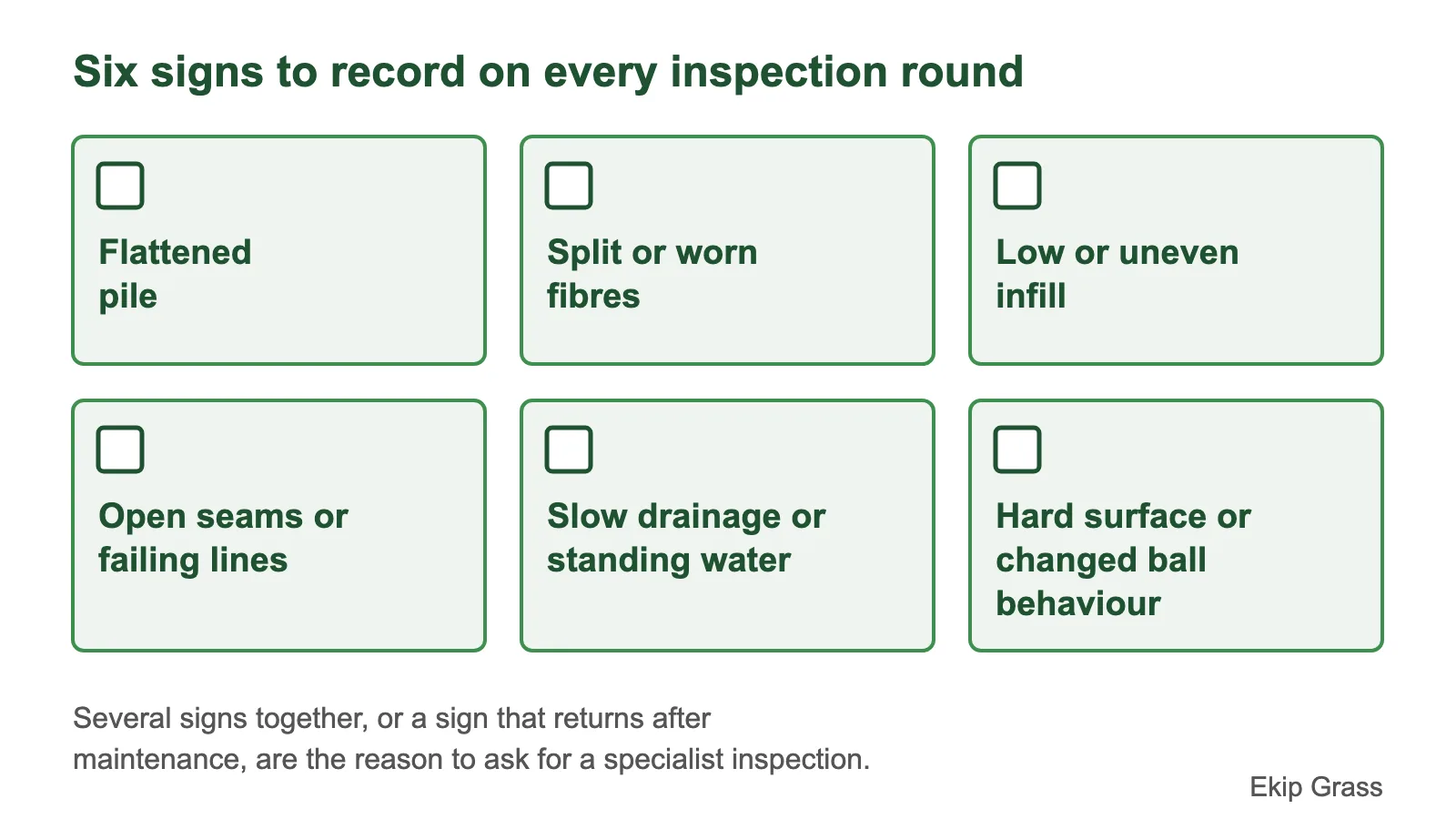
One sign alone often calls for maintenance. Several signs together, or a sign that returns after maintenance, are the reason to ask for a specialist inspection. The FA recommends a condition survey of the existing pitch, fencing and floodlighting for refurbishment projects.
Do FIFA Quality certificates expire?
Yes. Section 2.3 of FIFA's Test Manual II says a field's FIFA Quality certification is valid for three years and FIFA Quality Pro certification for one year. Certification ends sooner if a scheduled or random spot check finds the field no longer meets the programme, or if the football turf is removed or replaced. After a replacement a new field test must be conducted.
Section 2.4 allows a retest for a field that has been tested before and not modified since, while a resurfaced field gets an initial test. A field that passes the retest in full is recertified for a further year under FIFA Quality Pro or a further three years under FIFA Quality. A field that fails the FIFA Quality Pro requirements loses its certification, and FIFA Quality can then only be obtained through a new initial test.
A replacement date and a certificate date have to be planned together, because new carpet means a new initial field test. How certification works and what each mark means is explained on the FIFA Quality page.
Which parts are replaced and which can stay?
The carpet, meaning the pile and its backing, is what is lifted in a resurfacing. The FA guide describes resurfacing as including removal and disposal of the existing surface and infill. Infill and a shock pad, if one is fitted, are tested before any reuse, and the base and drainage need a specialist inspection.
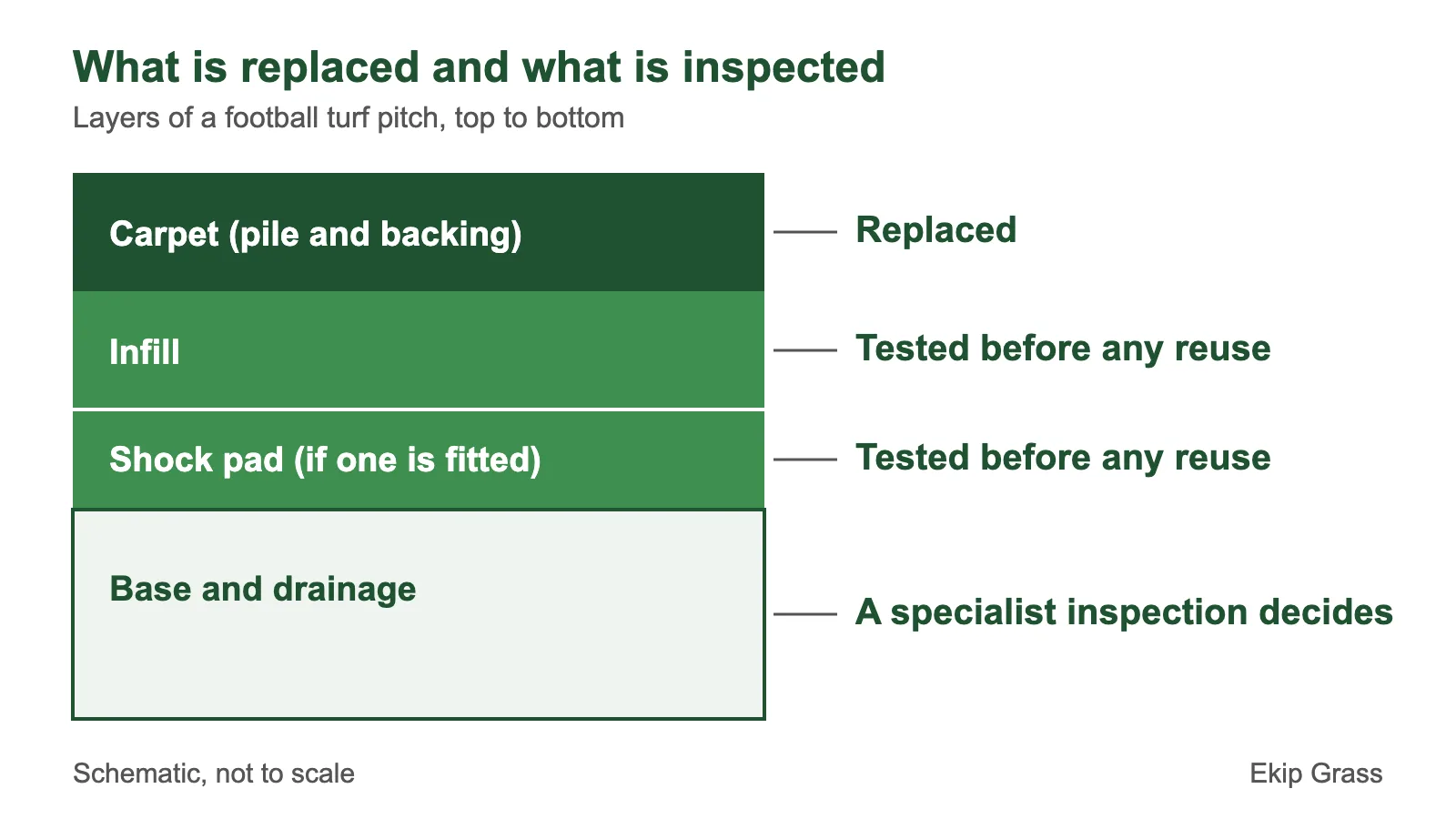
Infill can go into the new system if its particle size, particle shape, bulk density and composition meet FIFA's infill identification requirements. FIFA points to section 11 of EN 15330-5 for assessing reclaimed infill.
A shock pad or elastic layer can be kept if three conditions are met. Its peak shock absorption must lie between 90% and 110% of the value the manufacturer declared when the system was approved. Its deformation must be within 2 mm of the declared value, and its water permeability must be above 180 mm/h, a criterion that does not apply indoors. FIFA does not accept a result based on the corner areas alone. The FA guide adds that a retained shock pad must be tested by a FIFA-accredited test institute before tenders or quotations are requested, and that high-quality shock pads should last two or more carpet lives.
The official guidance cited here does not say whether the base layers and drainage can be kept. A specialist inspection decides.
What should a replacement plan cover?
- Commission a condition survey of the pitch, fencing and floodlighting, as the FA recommends for refurbishments.
- Test the shock pad before quotes are requested, and test the infill if you want to reuse it.
- If a competition requires a certificate, say so in the tender: the new system needs a new initial field test. Surface choices are compared in football pitch surface types.
- Settle the infill choice early. The EU microplastics rule for granular infill is covered in the infill guide linked above.
- Ask each bidder where the removed carpet and infill will go. The FA guide says lifting and disposal of existing carpets, infill and shock pads follow the Waste (England and Wales) Regulations 2011; elsewhere, national waste rules apply. The official guidance cited here describes no recycling route for old carpet, so do not assume one.
- Plan the works for a period when the pitch is not needed for fixtures. The FA guide has pitches in steps 1 to 6 of the National League System tested annually before the season commences, and no cited source names a month for resurfacing.
- Start the budget early. The Football Foundation has funded sites pay into a Pitch Replacement Fund and meets them at year eight to review the replacement strategy. The cost factors are set out in artificial football pitch cost.
How Ekip Grass can help
Ekip Grass manufactures football turf in Dilovası, Kocaeli, Türkiye, and is a licensee of the FIFA Quality Programme for Football Turf. Its systems are listed on the football grass page and in the football turf category, and the system data sheet is sent with the quote.

0 comments
Leave a comment
Your comment will be published after review.