

Summarize this article with AI Open a summary of this article in your preferred assistant
Football turf uses sand as stability infill and a performance infill on top. SBR, EPDM and TPE are synthetic polymers: under Regulation (EU) 2023/2055, granular infill for synthetic sports surfaces cannot be placed on the EU market from 17 October 2031. Existing pitches are not banned. Cork, other organic infill and non-infill carpets need a written position from the supplier.
Infill is the granular material brushed into the pile of a football turf carpet. Sand holds the carpet down and keeps the fibres upright, and a second layer, the performance infill, gives the surface its cushioning and ball behaviour. SBR, EPDM and TPE performance infills are synthetic polymers, and under Commission Regulation (EU) 2023/2055 granular infill for synthetic sports surfaces can no longer be placed on the EU market from 17 October 2031. Existing pitches are not banned, but a pitch specified today needs an infill plan that still works after that date.
What does infill do in a football turf system?
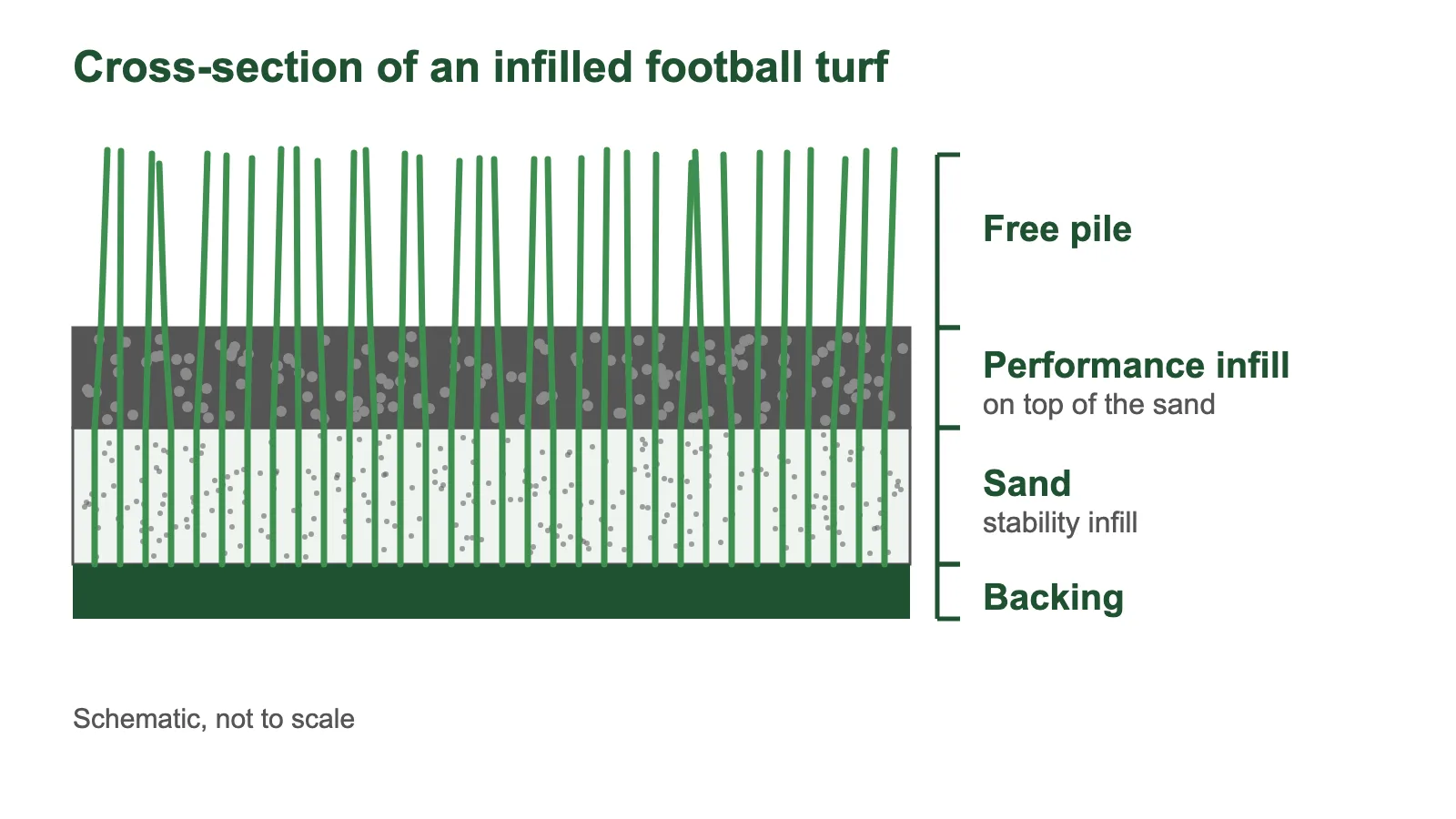
A football carpet has a long pile, and the infill fills its lower part. The upper part of the pile stays clear of the infill. This free pile is what the ball and the players' feet meet first.
Two layers do two jobs. The stability infill is normally sand: its weight keeps the backing flat and the fibres standing. The performance infill is spread on top of the sand. It sets how the surface absorbs impact, how the ball rolls and bounces, and how the pitch feels in a slide or a tackle. Some systems use sand only, and some carpets are built to need no performance infill at all.
The cross-section below shows the order of the layers. Sand under a garden lawn is a different matter and is covered in our guide to granite dust for artificial grass. The rest of this article is about sports pitches.
Which infill types are used on football pitches?
The table compares the materials in general terms. Playing behaviour and upkeep depend on the whole system, so read it as a list of questions for the supplier and not as a specification.
| Infill | What it is | How it plays and feels | Upkeep | Status under the EU rule |
|---|---|---|---|---|
| Sand (stability infill) | Mineral grains | Adds weight and stability. Gives no cushioning of its own. | Needs levelling by brushing and can compact with use. | Mineral, not a polymer, so outside the definition. |
| SBR | Styrene-butadiene rubber granules, usually ground from recycled tyres | Dark, resilient and cushioning. Can become hot in strong sun. | Needs topping up and levelling. Granules can leave the pitch on boots and with water. | Synthetic polymer. Restricted from 17 October 2031. |
| EPDM | Synthetic rubber granules made for the purpose, available in colours | Cushioning similar in kind to SBR, with a lighter colour option. | Same top-up and containment questions as SBR. | Synthetic polymer. Restricted from 17 October 2031. |
| TPE | Thermoplastic elastomer granules made for the purpose | Cushioning layer, available in colours. | Same top-up and containment questions as SBR. | Synthetic polymer. Restricted from 17 October 2031. |
| Cork | Natural cork granules | Lighter than rubber. Some suppliers say it stays cooler in sun, so ask for measurements. | Light granules may move with heavy rain, so ask for the supplier's guidance. | Not named in the text. Depends on the exclusions below and on any coating or binder. |
| Other plant-based infill (for example coconut husk) | Natural fibre or particle material, often used with sand or cork | Varies with the material and the mix. | Ask how fast the material breaks down and when it must be replaced. | Not named in the text. Same check as cork. |
The choice is made for how the pitch should play as well as for the rule. A club that wants a softer surface and a municipality that wants low upkeep can reasonably pick different systems. How the infill fits into the carpet decision is covered in our guide on how to choose artificial grass, and what it adds to a project budget is covered in the guide to artificial football pitch cost.
What does the EU microplastics rule restrict?
The restriction on synthetic polymer microparticles applies "from 17 October 2031 for granular infill for use on synthetic sports surfaces" (Commission Regulation (EU) 2023/2055, REACH Annex XVII entry 78, point 6(j)).
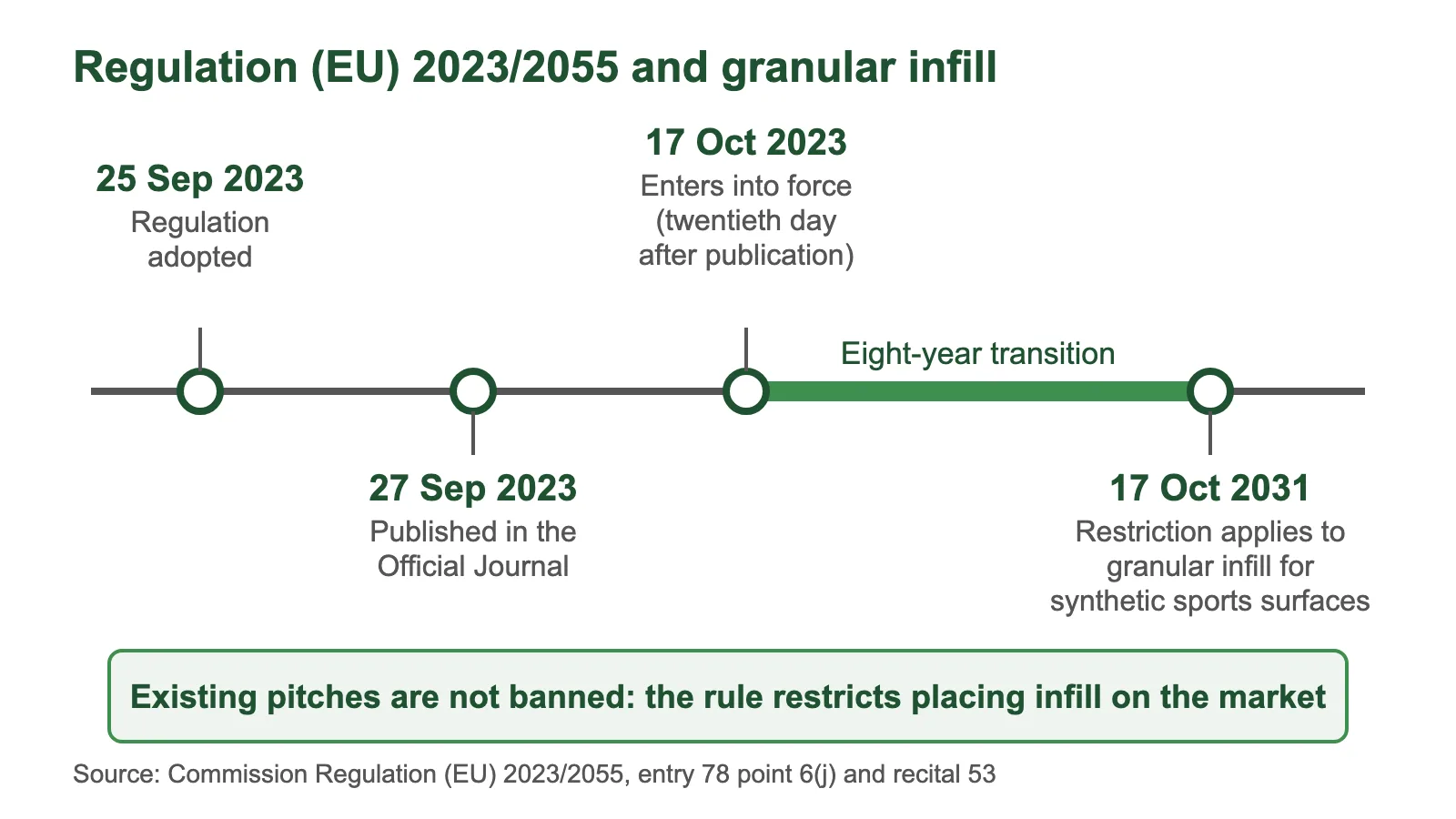
Commission Regulation (EU) 2023/2055 was adopted on 25 September 2023 and published in the Official Journal on 27 September 2023. It entered into force on the twentieth day after publication, which is 17 October 2023. It adds entry 78 on synthetic polymer microparticles to Annex XVII of REACH, the EU chemicals regulation.
Entry 78 defines those microparticles as solid polymers in particles of 5 mm or less in every dimension, with further conditions in the full definition. Paragraph 1 bars placing them on the market, as substances on their own or, where they are present to confer a sought-after characteristic, in mixtures at 0.01 % by weight or more. For sports surfaces, point 6(j) sets the date: the bar applies from 17 October 2031 to granular infill for use on synthetic sports surfaces.
The date follows an eight-year transition period. Recital 53 gives the reason: the Commission wanted more of the existing synthetic sports surfaces to reach the natural end of their life before they have to be replaced.
The regulation does not ban existing pitches. It restricts placing infill on the market, and the text does not order a pitch to be closed, emptied or relaid. Read plainly, buying new restricted granules after 17 October 2031, top-up material included, falls under the restriction, so ask your national enforcement authority how it applies to maintenance supplies. This is EU law with EEA relevance. Other rules apply outside the EU and EEA, and this article does not cover them.
Are cork, plant-based infill and sand inside the rule?
The regulation lists no infill materials. It defines a group of polymers and then excludes some of them, so the question always concerns the specific material in the specific product.
The text excludes four kinds of polymer: those formed by a polymerisation process in nature and not chemically modified; those shown to be degradable under Appendix 15; those with a solubility above 2 g/L under Appendix 16; and those with no carbon atoms in their structure. Cork and other plant-based materials are not named. The supplier has to document which exclusion a given product relies on, and suppliers who claim degradability or solubility must provide proof to the authorities on request.
Sand is a mineral and not a polymer, so the definition does not reach it. One detail matters for natural granules: the definition also covers a polymer that forms a continuous surface coating on particles. A cork or plant granule that is coated or bound with a synthetic polymer needs its own check.
Which turf systems avoid granular infill?
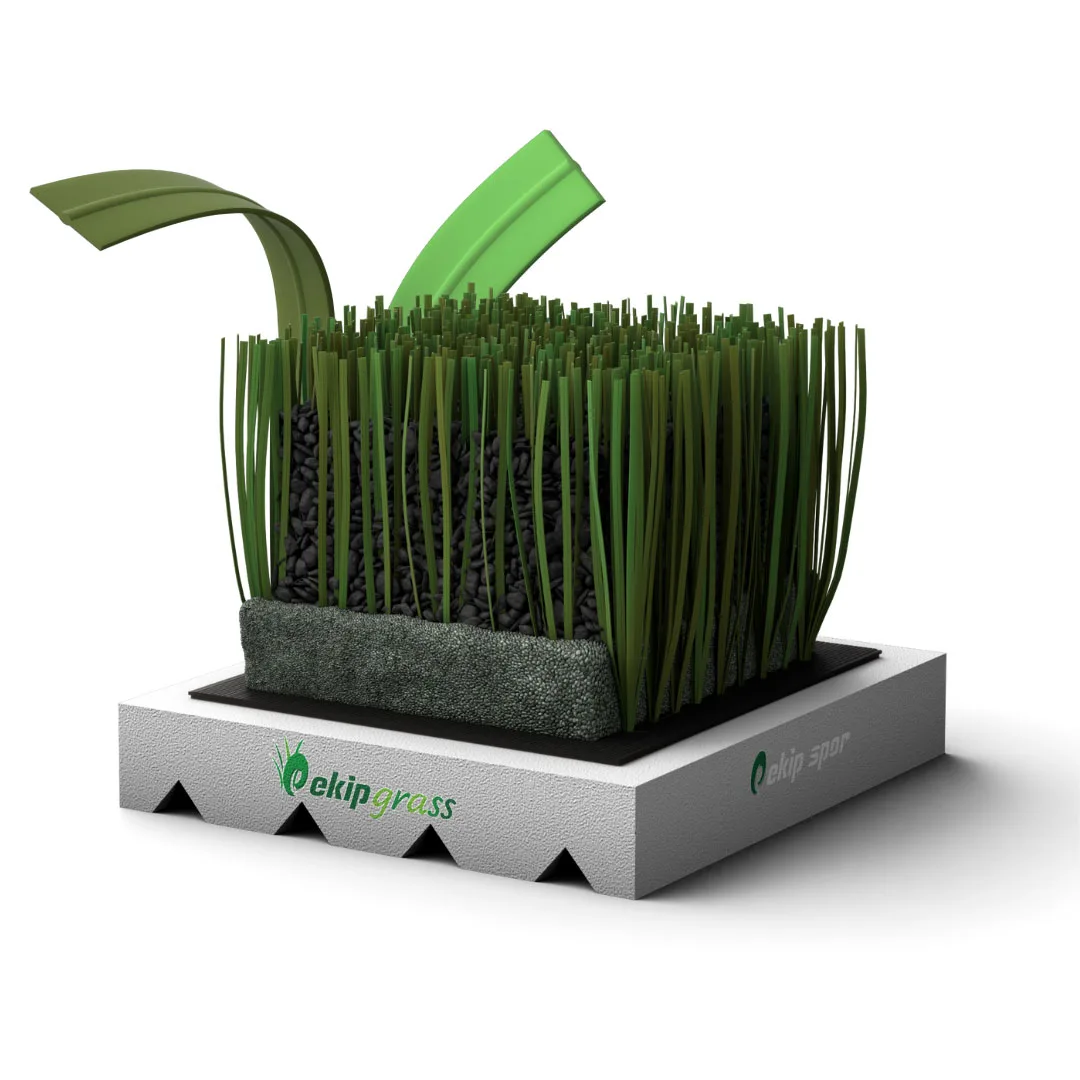
A carpet can be built to stand without a performance infill. Ekip Grass Non-Infill Grass is one example: straight and curled yarns are tufted together, and the curled yarn fills the base of the pile. The product page lists a 30–35 mm pile, 16,000 dtex yarn, no rubber granules and a small amount of silica sand, with football pitches and landscaping as its uses.
A carpet like this plays differently from a long-pile pitch with a cushioning layer. Check it against the sport, the level of play and any certification you need. The system data sheet is sent with the quote.
The Ekip Grass Pro Odin and Odin pages list the infill as "SBR rubber or eco infill over sand, set per project". The product data does not define "eco infill". For an EU pitch, the project specification should therefore name the exact material and its position under entry 78, and this is a fair question to put to any supplier, Ekip Grass included. The football turf page describes the systems.
What should a tender or supplier quote say about infill?
Ask for these items in writing so that offers can be compared line by line.
- Each infill layer by material and product name, with the quantity per square metre.
- For each performance infill, the supplier's statement on entry 78: outside the definition and which exclusion applies, or inside it with the 17 October 2031 date.
- Whether any granule is coated, bound or mixed with a polymer.
- Where degradability is the claim, the Appendix 15 test method and its result.
- Where certification is required, the test report of the carpet system with that exact infill. The Ekip Grass Pro Odin page says a new pitch carries a FIFA Quality certificate only after its own on-site field test, so the base, the infill and the installation have to follow the tested system. The programme is described on the FIFA Quality page.
- A top-up plan: how much material, at what interval, and which material will be supplied after 17 October 2031.
- How the infill is kept on the pitch. Recital 41 of the regulation cites the CEN technical report TR 17519, guidance on how to minimise infill dispersion into the environment.
- Who removes the infill at the end of the pitch's life and where it goes.
0 comments
Leave a comment
Your comment will be published after review.