
Summarize this article with AI Open a summary of this article in your preferred assistant
An artificial turf specification sheet lists yarn (type, profile, dtex, filaments per tuft), construction (pile height, gauge, stitch rate, tufts per m², face weight, backing) and infill. Gauge and stitch rate give tufts per m²; dtex, density and pile height give face weight. The sheet does not show installed performance.
An artificial turf specification sheet lists three groups of values: the yarn (type, profile, dtex and filaments per tuft), the carpet construction (pile height, gauge, stitch rate, tufts per m², face weight, backing) and the infill. The values are linked. Gauge and stitch rate give the number of tufts per square metre, and dtex, density and pile height give the face weight. A sheet describes what the carpet is made of; how an installed pitch plays is measured elsewhere.
This guide is for buyers, distributors and contractors comparing data sheets. For the wider decision of which surface to buy, see how to choose artificial grass. How a tufting machine builds the carpet is covered in how artificial grass is made.
What do the yarn lines tell you?
The yarn lines give the material, the fibre shape and how much yarn each tuft holds. Pro Odin Grass lists "PE monofilament, spine profile, 1.4 mm wide" and "12,000 dtex, 6 filaments per tuft".
PE is polyethylene. A monofilament is a single extruded fibre with a fixed profile, such as a spine or an omega shape. A fibrillated yarn starts as a film that splits into a net of fine strands, and a curled (texturised) yarn is crimped so that it stays low and dense. Ekip describes the spine of its Odin yarn as a raised rib that helps the fibre stand back up after play. A sheet names the choice between monofilament and fibrillated yarn without measuring its effect.
Dtex is the mass in grams of 10,000 metres of yarn, so 12,000 dtex is 1.2 g for every metre of yarn. If the dtex is the total for the tuft, as Ekip words it for Pro Odin ("six filaments per tuft, 12,000 dtex in total"), each filament weighs 12,000 ÷ 6 = 2,000 dtex. The same total over four filaments gives 3,000 dtex each, a different fibre. Dtex alone says nothing about pile height or density, so it cannot rank two carpets.
What do pile height, gauge and stitch rate describe?
Pile height is the length of fibre standing above the backing, in millimetres. Football turf carries long tufts that leave room for infill, while padel and tennis carpets use short piles for a true ball bounce.
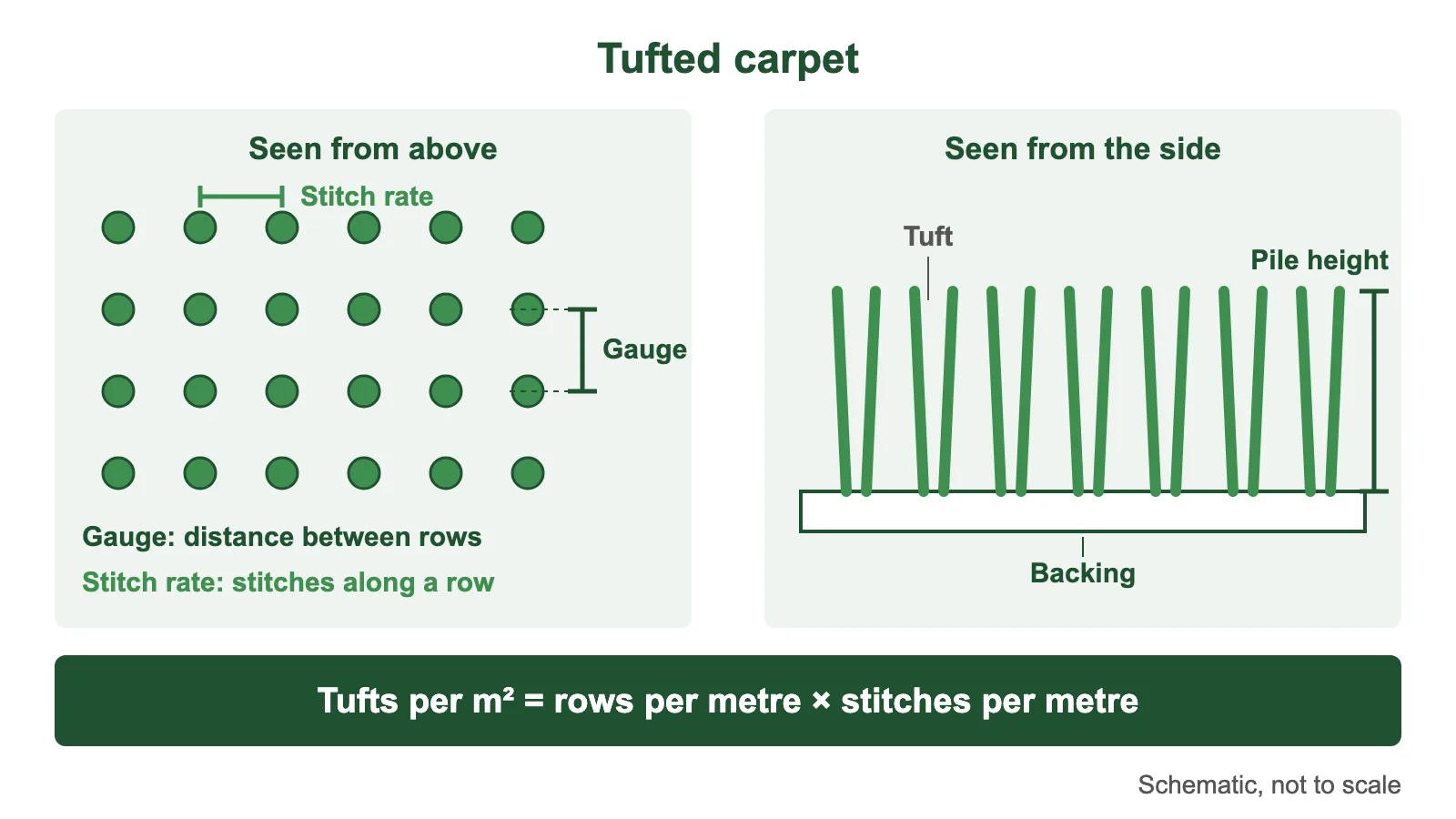
Gauge is the distance between two rows of tufts. Sheets give it in inches as a fraction or in millimetres. One inch is 25.4 mm, so 3/8 inch is 0.375 × 25.4 = 9.525 mm and 5/8 inch is 0.625 × 25.4 = 15.875 mm. Some sheets give a count of needles per length instead, and there a bigger number means denser rows, so check which one you have.
Stitch rate is the number of stitches along one row, per metre or per 10 cm. 16 stitches per 10 cm is 160 per metre. A rate per inch converts the same way: 4 stitches per inch is 4 ÷ 0.0254, about 157 per metre. Only the two together set the density.
How do the numbers connect?
Rows per metre are 1,000 ÷ gauge in millimetres, and tufts per m² = rows per metre × stitches per metre. Example with round numbers, not an Ekip product: a gauge of 5/8 inch is 15.875 mm, which gives 1,000 ÷ 15.875 = 62.99, about 63 rows per metre. At 160 stitches per metre that is 63 × 160 = 10,080 tufts per m². If a sheet lists gauge, stitch rate and tufts per m², the three must agree.
Face weight is the mass of yarn above the backing per m². A simple estimate starts with dtex ÷ 10,000, which gives grams per metre of yarn. Each stitch stands as a loop with two legs, so the yarn above the backing is 2 × pile height, multiplied by the tufts per m². With 12,000 dtex, a 40 mm pile and 10,000 tufts per m², 1.2 g per metre × 0.08 m = 0.096 g per tuft, and 0.096 × 10,000 = 960 g/m². The model ignores yarn buried in the backing and any difference in how the dtex is quoted, so treat it as a plausibility check.
Face weight is also given in ounces per square yard. One ounce is 28.3495 g and one square yard is 0.9144 × 0.9144 = 0.8361 m², so 1 oz/yd² = 28.3495 ÷ 0.8361 = 33.906 g/m². That makes 40 oz/yd² equal to 40 × 33.906 = 1,356 g/m².
What do total weight, backing and infill add?
Total weight is usually the face weight plus the primary backing fabric and its coating, which is latex or polyurethane. Two carpets with the same face weight can differ in total weight through the backing alone, so check what the sheet includes. The sheet should also name the coating and say whether the backing is perforated for drainage.
Infill is the material poured between the fibres. Its line should name the material and the quantity per m². Ekip lists "SBR rubber or eco infill over sand, set per project" for Pro Odin.
How do you read real Ekip product rows?
The rows below are copied from the product pages of four Ekip models. Where a page has no separate entry, the cell says so.
| Product | Yarn | Yarn decitex | Pile height |
|---|---|---|---|
| Pro Odin Grass | PE monofilament, spine profile, 1.4 mm wide | 12,000 dtex, 6 filaments per tuft | 55–60 mm (FIFA-listed version) |
| Cleopatra Grass | PE monofilament, omega profile, 4 filaments per tuft | 10,600 dtex | 20–65 mm, stitch rate set to the order |
| Multi Sport Grass | Not listed on the product page | 5,500 dtex | 13–30 mm; 35 mm for small-sided pitches |
| Padel Grass | Curled (texturised) yarn, 8,000 dtex, or fibrillated yarn, 5,500 dtex | Given in the yarn line | 11, 13 or 15 mm |
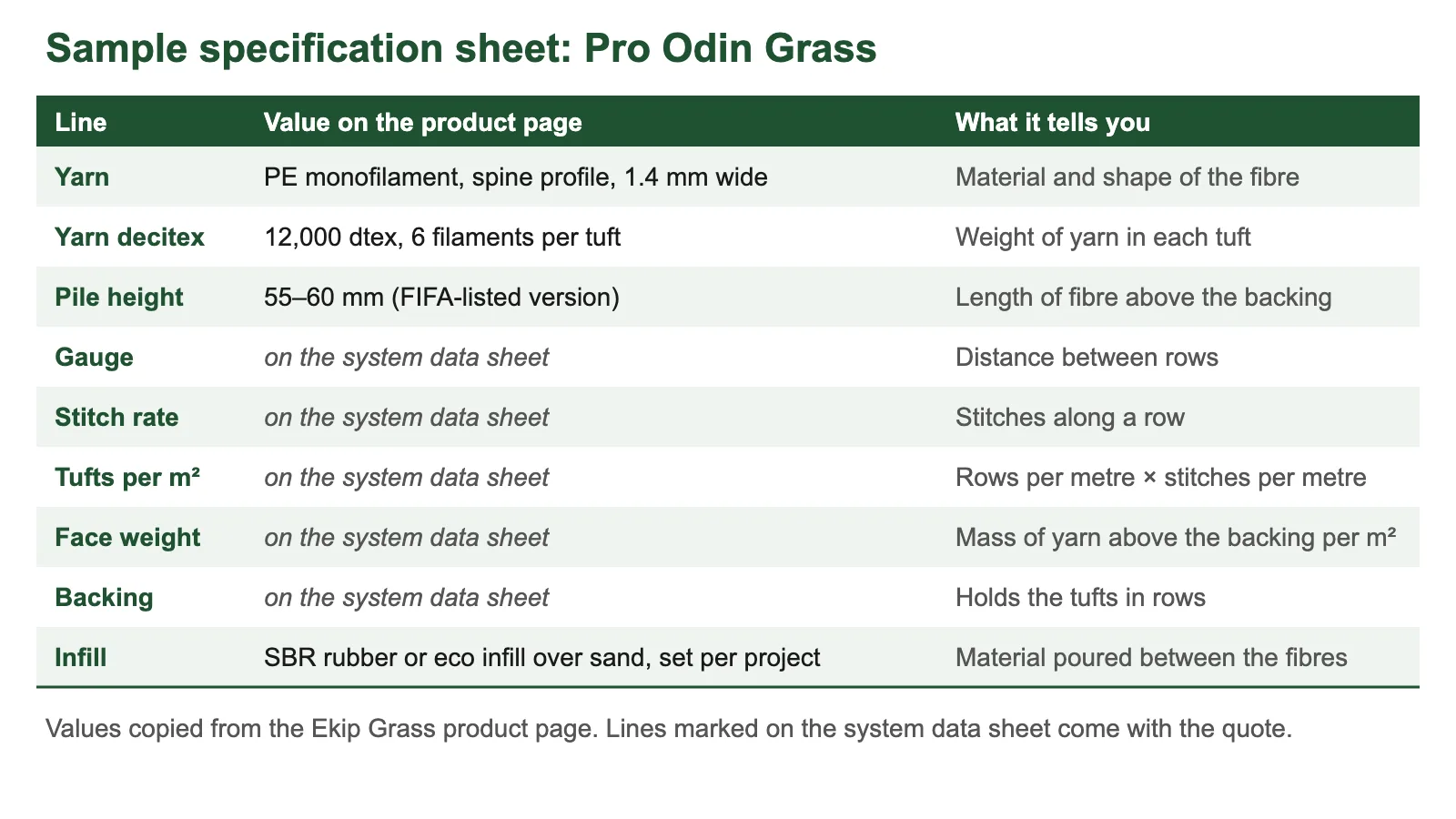
The Pro Odin pile height reads "55–60 mm (FIFA-listed version)", so that range belongs to the version FIFA lists. The same yarn on Odin Grass is listed as "20–65 mm; 40–60 mm recommended for football". The Pro Odin page does not list gauge, stitch rate, tufts per m², face weight or backing. Those lines are on the system data sheet that comes with the quote. Figure 2 shows the Pro Odin lines and what each one tells you.
Cleopatra Grass has four filaments per tuft at 10,600 dtex, and its pile line says "stitch rate set to the order". Because the order fixes the stitch rate, two Cleopatra quotes can differ in tufts per m² and face weight while the page reads the same, so those figures belong on the quote sheet.
Multi Sport Grass lists 5,500 dtex, and Ekip says it is produced densely to make up for the lighter yarn. The arithmetic shows the scale: 12,000 ÷ 5,500 = 2.18, so at the same pile height a 5,500 dtex carpet needs about 2.2 times as many tufts to carry the yarn mass of a 12,000 dtex one.
Padel Grass lists two yarns in one line, and the sheet for your court must say which one it covers. Dtex compares weight only, and the two structures differ, so the number does not rank them. More football turf models are on the football turf category page.
What does a specification sheet leave out?
A specification sheet tells you what the carpet is made of. How the installed pitch plays is shown by testing the installed system.
It leaves out performance. A sheet lists construction, while the behaviour of the ball and the feel underfoot depend on the installed system of turf, infill, base and any shock pad, and they are measured on that system. FIFA describes its Quality Programme as laboratory testing of the product followed by testing of the final installation. Both phases cover how the player and the ball interact with the surface, product composition, weather resistance, seam strength and service life, and the benchmark is "a natural grass pitch in good condition" (FIFA). Ekip's listed products and pitches are on the FIFA Quality page, and the company documents are on the certificates page.
Most sheet values are declared by the manufacturer. A declared 12,000 dtex is the intended value, and a measured value comes from a test on a sample. A sheet that gives one figure with no tolerance cannot be checked on delivery. Ask for the tolerance, the test method (standard and year) and the sample it was measured on.
Which questions help when you compare sheets?
Put these to each supplier in writing:
- Are all values in the same units, and is the gauge a distance or a needle count?
- Is the dtex the total for the tuft or for one filament?
- Do gauge, stitch rate and tufts per m² agree?
- What are the face weight and total weight, what does each include, and what are the tolerance and test method?
- Which backing coating and which infill type and quantity per m²?
- Which system data sheet and test report belong to the exact version quoted?


0 comments
Leave a comment
Your comment will be published after review.