
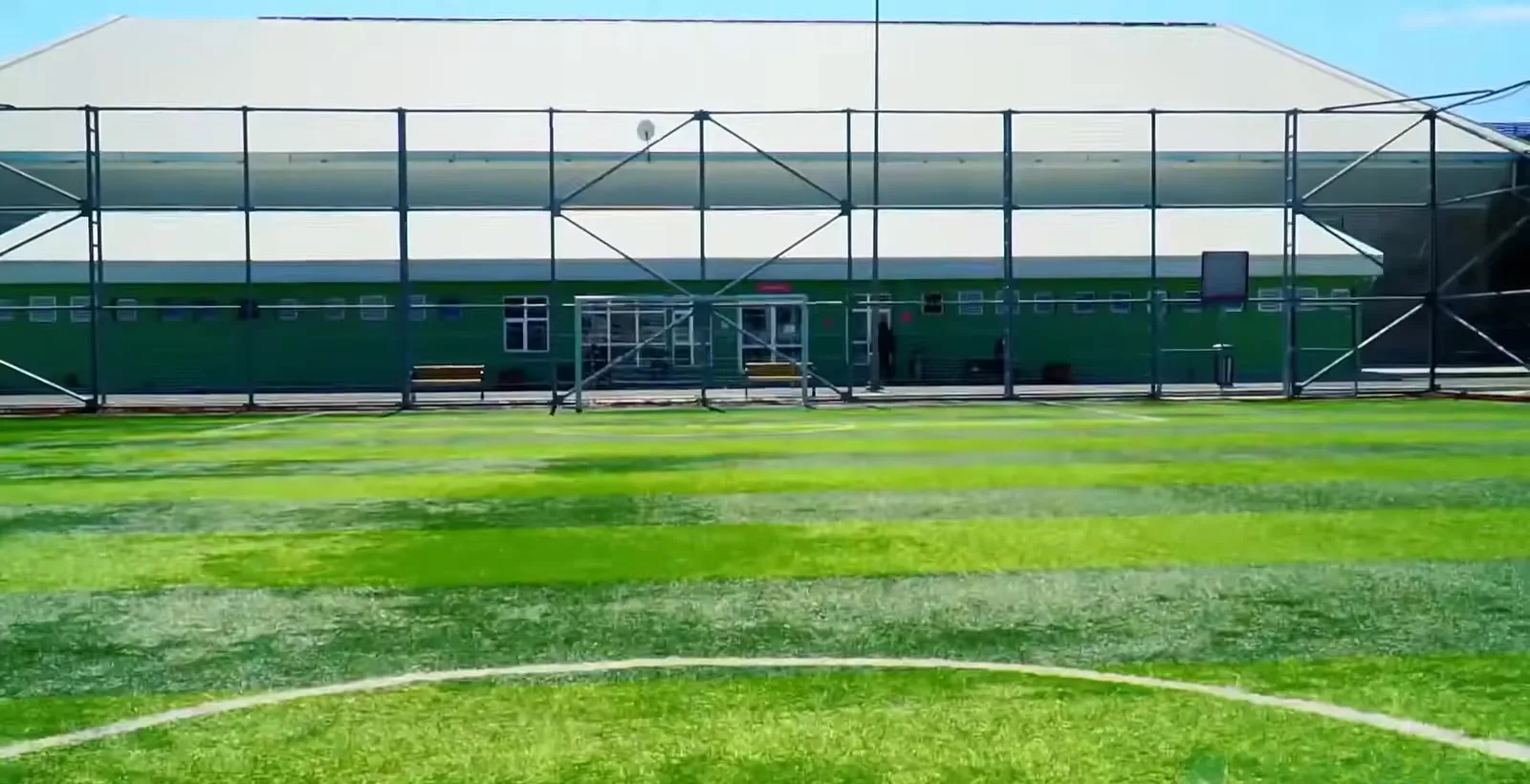
On a 3G pitch with sand and rubber infill, wear boots with moulded or rubber studs made for artificial turf, usually sold as AG. TF boots suit short-pile and non-infill surfaces, and FIFA does not recommend metal studs. The notice at the pitch decides.
On a 3G pitch with sand and rubber infill, wear boots with moulded or rubber studs made for artificial turf, which in the shop usually means AG. Turf (TF) boots with small rubber pimples suit short-pile and non-infill surfaces. Metal studs are the type FIFA's pitch signage does not recommend. The footwear notice at your own pitch decides, because the operator writes it for that carpet.
We make football turf, so this guide starts from the surface: what a stud meets on the way down, and what FIFA's laboratory test measures when a foot turns on it.
What does a stud meet on a 3G pitch?
Football turf is a long-pile carpet with infill brushed in between the fibres. On our standard 55 mm Odin Grass football pitches we brush in 30 kg/m² of silica sand first and spread 8 kg/m² of black SBR granules on top. Quantities vary by carpet model. The top of the pile stays clear of the infill, and this free pile is the first thing a boot touches. The materials are covered in our guide to artificial turf infill types.
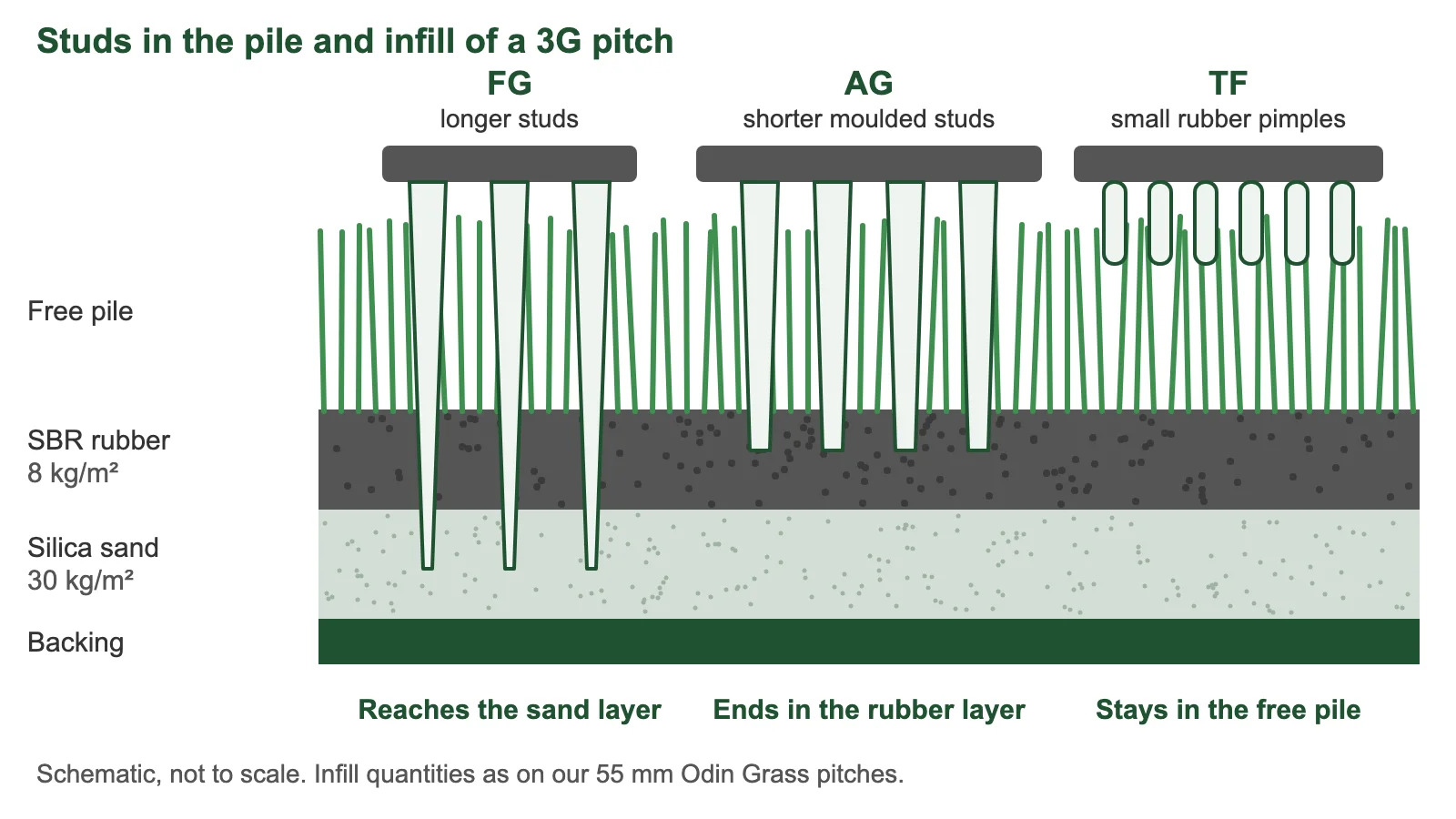
Below the free pile, a stud enters the rubber layer, which is there to give under load. A long stud can pass through it and reach the sand layer, whose job is to keep the carpet backing flat. The deeper a stud sits in the infill, the more it resists when the foot turns, so stud length changes how much grip a player gets on the same pitch. In the drawing, FG studs reach the sand layer, AG studs end in the rubber layer and TF pimples stay in the free pile.
Summarize this article with AI Open a summary of this article in your preferred assistant
Which stud type goes with which surface
The letters on a boot box say what ground the studs were designed for. Makers use them a little differently, so judge the shape of the studs on the sole as well as the code.
| Boot type | What the sole looks like | Surface it is made for | On a 3G pitch |
|---|---|---|---|
| FG (firm ground) | Longer studs, often bladed or sharply tapered, built to dig into soil | Natural grass | Depends on the stud shape and the pitch rules; blades are left to the pitch operator |
| AG (artificial grass) | Shorter, more numerous moulded studs, often conical or hollow | Long-pile 3G with sand and rubber infill | The usual choice |
| MG (multi-ground) | A soleplate meant to cover natural grass and artificial turf, with a stud pattern between FG and AG | Mixed use | Depends on the stud shape (see the questions below) |
| TF (turf) | Many small rubber pimples instead of studs | Short-pile and non-infill turf | The pitch operator decides on a long-pile carpet |
| Metal studs | Removable studs with metal tips | Soft natural grass | Not recommended by FIFA |
| Flat-soled shoes | No studs | Indoor floors | On FIFA's prohibited list |
The FA's Guide to 3G Football Turf Pitch Design Principles and Layouts has a footwear table that reflects the views of carpet manufacturers. It marks moulded-stud boots as suitable for a long-pile 3G carpet, and it marks bladed boots and trainers as dependent on the pitch operator.
Pile height and infill decide how far a stud goes
Our long-pile football carpets are where AG studs have rubber to enter. Odin Grass has a 20–65 mm pile range, and we recommend 40–60 mm for football. Pro Odin Grass, the FIFA-listed version of Odin, has a 55–60 mm pile. On these systems the sand and rubber layers give a stud a layer made to take it.
Non-infill and short-pile surfaces give a stud far less depth. Our Non-Infill Grass has a 30–35 mm pile of 16,000 dtex yarn, with curled yarn filling the base of the pile and a small amount of silica sand instead of rubber granules. A long stud has no rubber layer to sink into there, so short studs or turf pimples are usually the better fit. Our Multi Sport Grass is 13–30 mm, and 35 mm for small-sided pitches, and the same reasoning applies.
Pile height, yarn and infill for a pitch are in the system data sheet we send with every quote, and our football pitch systems are described on the football grass page.
How does FIFA measure the grip between boot and surface?
FIFA's Test Manual II for the FIFA Quality Programme for Football Turf (2024 edition) sets limits for peak torque, the twisting resistance of the surface. FIFA's page on the manual says a rotational traction athlete device determines peak torque, torque at 10° and rotational shear stiffness, as part of the manual's methods for assessing player-to-surface interactions.
The limits are 30 to 45 Nm for FIFA Quality PRO and 25 to 50 Nm for FIFA Quality. A sample is measured with its infill dry, wet and after a wear simulation of 6,000 cycles, and each result has to fall inside the range.
The range has a floor and a ceiling. Below it the foot slips. Above it a planted foot may not release when the player turns, and the load passes into the foot and leg. FIFA's footwear note in the same manual puts this into practice: it recommends only moulded or rubber studs made for artificial turf, because that footwear gives appropriate traction while reducing the risk of excessive grip and slipping. It adds that metal studs, flat-soled shoes and non-football footwear may increase the risk of injury and damage the turf system.
Our FIFA-listed systems are on the FIFA Quality page.
Worn and compacted pitches change how studs feel
The FA's guide says 3G pitches degrade with age and use, and that a neglected, heavily contaminated pitch over-compacts, which reduces its performance and life. It also says no rubber should be visible on the surface and the pile should stand upright. On a pitch where the pile lies flat, a stud meets less free pile and firmer infill than the boot was chosen for. Brushing, top-ups and replacement are covered in how long an artificial football pitch lasts.
What can a pitch owner put in the footwear rules?
FIFA has developed pitch signage that recommends moulded or rubber studs made for artificial turf, and The FA tells operators to put up a board of dos and don'ts for their surface after talking to the carpet manufacturer. A rule that follows both documents can read:
- Moulded or rubber studs made for artificial turf are allowed.
- Metal studs are not allowed.
- Flat-soled shoes are on FIFA's prohibited list. Where children train in trainers, the operator and the pitch supplier agree the extra maintenance.
- Bladed boots follow the carpet manufacturer's footwear policy.
The footwear policy also bears on how long the surface lasts. The Football Foundation expects a well maintained 3G surface used within the manufacturer's footwear policy to last between 10 and 12 years.

0 comments
Leave a comment
Your comment will be published after review.