
Summarize this article with AI Open a summary of this article in your preferred assistant
Football pitches use three main surface types: natural grass, hybrid grass (natural grass reinforced with synthetic fibres) and artificial turf. The IFAB Laws of the Game allow a wholly natural surface or, where competition rules permit, a wholly artificial or hybrid one; artificial surfaces must be green.
Football pitches are built on three main surface types: natural grass, hybrid grass and artificial turf. Natural grass grows in a soil or sand rootzone, hybrid grass reinforces that rootzone with synthetic fibres, and artificial turf replaces living grass with synthetic yarn and infill. Hard courts made of asphalt, concrete or acrylic coatings are also used for informal play, but they are not football turf.
What surfaces do the Laws of the Game allow?
The IFAB Laws of the Game state in Law 1 that the field of play must be a wholly natural or, if competition rules permit, a wholly artificial playing surface, except where competition rules permit an integrated combination of artificial and natural materials (a hybrid system). Artificial surfaces must be green.
For international matches between national representative teams and international club competitions, an artificial surface must meet the requirements of the FIFA Quality Programme for Football Turf, unless The IFAB gives special dispensation. Lower competitions set their own rules.
How do the main surface types compare?
| Surface | How it is built | Where it is used | Main upkeep |
|---|---|---|---|
| Natural grass | Living turfgrass on a soil or sand rootzone | Stadiums, clubs, schools, parks | Mowing, irrigation, feeding, rest and recovery time |
| Hybrid grass | Natural grass rootzone reinforced with synthetic fibres | Stadiums and training grounds | Same as natural grass, plus specialist care of the fibres |
| Infilled artificial turf | Synthetic yarn tufted into a backing, with sand and performance infill | Community, club, school and commercial pitches | Brushing, infill top-up, debris removal |
| Non-infill artificial turf | Dense yarn construction with little or no infill | Small-sided pitches, landscaping | Brushing, debris removal |
| Hard courts | Asphalt or concrete, sometimes with an acrylic coating | Informal and multi-sport courts | Cleaning, recoating |
What is natural grass, and when does it suit?
Natural grass is the traditional surface and the reference that artificial systems are compared with. It needs sunlight, water, mowing and time to recover after play. Where the number of playing hours is limited and there is staff and budget for groundskeeping, it remains a common choice. In shaded stadiums, cold climates or under heavy use, keeping it in playing condition becomes harder.
What is hybrid grass?
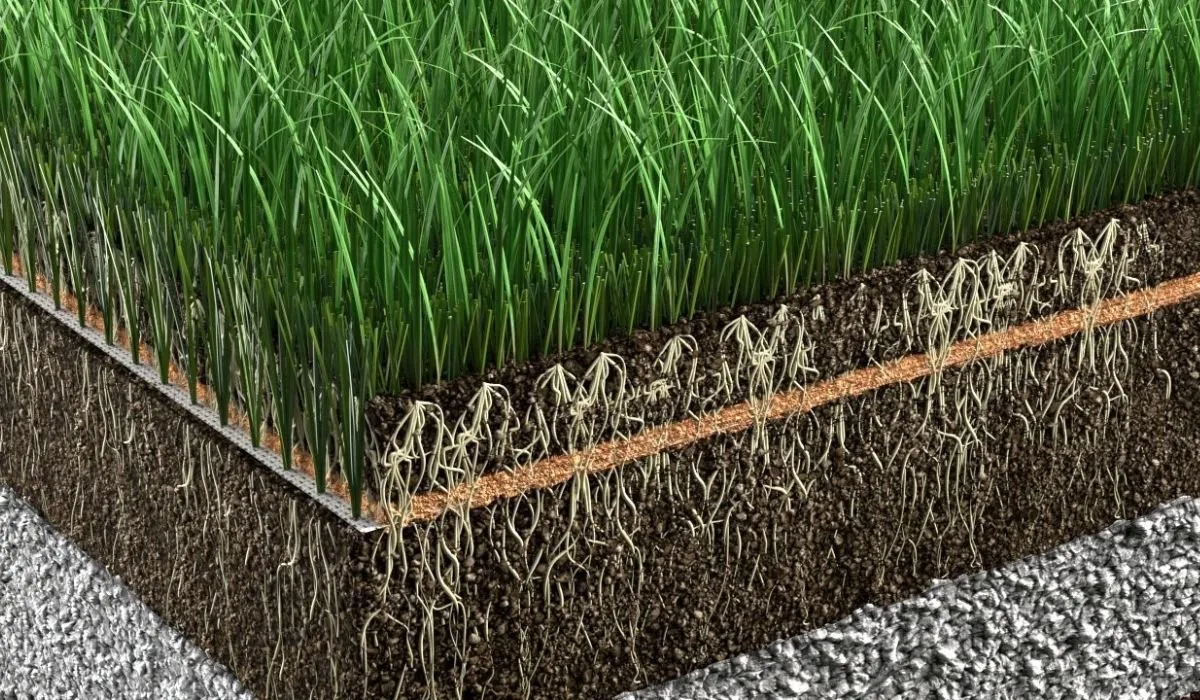
A hybrid pitch is still a natural grass pitch, but the rootzone is reinforced with synthetic fibres. The fibres anchor the roots and help the surface stay stable under heavy use, while players still play on living grass. Hybrid systems need the same light, water and mowing as natural grass. A general comparison is in hybrid grass vs artificial grass, and system details are on the hybrid grass page.
How is an artificial turf pitch built?
An artificial turf pitch is a layered system. From the bottom up it usually has a compacted, drained base, an optional shock pad, the turf carpet, a stabilising layer of sand and a performance infill such as rubber granules or another material. Non-infill designs rely on a dense, textured yarn instead. This kind of surface is often called 3G.
Two reference points are common. EN 15330-1 is the European standard for synthetic turf surfaces for outdoor sports. The FIFA Quality Programme for Football Turf tests the product in the laboratory and then the final installation on site; FIFA awards the FIFA QUALITY mark to pitches meeting the standard for community and amateur pitches and the FIFA QUALITY PRO mark to pitches for professional-level football.
Within artificial turf, the choice between infilled and non-infill designs depends on use. Infilled systems are the usual route for full-size and club pitches, where the sand and performance infill help control how the ball rolls and how the surface responds under foot. Non-infill turf avoids loose granules and needs less infill management, which can suit small-sided pitches and areas where infill migration is a concern. The product data sheet and, where needed, test reports show what a given system is designed for.
What other surfaces are used for football?
Hard courts of asphalt or concrete, sometimes with an acrylic coating, host informal games and multi-sport activity. Indoor halls often use sports flooring rather than turf; see indoor sports flooring for that type of surface. Neither is football turf in the sense used by the FIFA Quality Programme.
Ekip Grass football turf systems
Ekip Grass manufactures football turf in Dilovası, Kocaeli, Türkiye. It is a licensee of the FIFA Quality Programme for Football Turf and holds a TSE certificate for TS EN 15330-1 football turf. Its systems are listed under football turf, and the licence is explained on the FIFA Quality page.
0 comments
Leave a comment
Your comment will be published after review.