
Summarize this article with AI Open a summary of this article in your preferred assistant
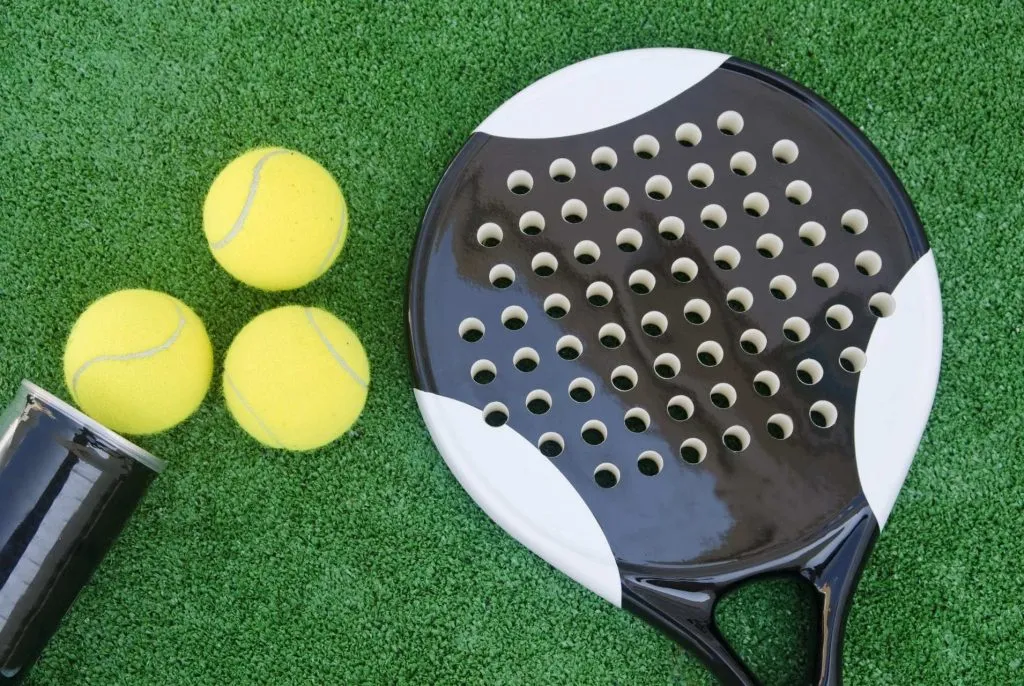
Padel is a racket sport played in pairs on an enclosed court. The International Padel Federation (FIP) Rules of Padel set the court at 10 m wide by 20 m long (interior), with a net 0.88 m high at the centre. The ball may be played off the walls after it bounces, and the surface may be cement, synthetic material or artificial grass.
Padel is a racket sport played in pairs on a fully enclosed court, where the ball may be played off the walls after it has bounced. The Rules of Padel published by the International Padel Federation (FIP), in the edition applying from 1 January 2026, set the court as a rectangle 10 meters wide by 20 meters long, measured on the interior. Scoring follows the familiar 15, 30, 40, game sequence, and serves are hit underarm after a bounce.
How is padel played?
Two pairs face each other across a net. Under the FIP rules, the server bounces the ball behind the service line and must hit it at or below waist height, sending it diagonally into the opponent's service box. Each side has two serve attempts.
After the ball bounces on the opponent's side, it may hit the glass or wall and stay in play, and players can also play the ball off their own walls to return it. A point is lost if the ball bounces twice, or if a returned ball hits the opponents' walls or fence before bouncing on their ground.
The FIP rules decide a match over three sets, so the first pair to win two sets wins the match. A set is won at six games by a margin of two, with a tie-break at six games all. They also describe alternative scoring methods, such as the golden point, that organisers may announce in advance.
What are the dimensions of a padel court?
The figures below are taken from the FIP Rules of Padel (review of application 01.01.2026), section "The Court".
| Element | As stated in the FIP Rules of Padel |
|---|---|
| Playing area | 10 m wide by 20 m long (interior measurements), 0.5% tolerance |
| Service lines | 6.95 m from the net on each side |
| Line width | 5 cm |
| Net | 10 m long, 0.88 m high at the centre, rising to 0.92 m at the ends |
| End enclosures | 4 m total height: 3 m of wall plus 1 m of metallic fence |
| Clear height over the court | Minimum 6 m; 8 m suggested for new facilities |
| Safety area for out-of-court play | No obstacles within at least 3 m wide (4 m recommended), 4 m long and 3 m high on either side |
For the side enclosures the rules allow two variants: stepped walls at both ends with metallic fencing between, or a 3 m high by 4 m long wall at each end without a step, completed by metal mesh. The walls may be glass, brick or another material, as long as the surface is hard, smooth and gives a uniform bounce.
Which surfaces are allowed on a padel court?
The FIP rules state that the court surface may be made of cement, synthetic material or artificial grass, provided it allows a regular bounce of the ball. They also set these conditions:
- The preferred colours are green, blue or terracotta, in one colour for the whole floor, clearly different from the wall colour.
- Level differences inside the court must be less than 3 mm, measured with a 3 m rule.
- For surfaces without drainage, the maximum transverse slope is 1% from the centre towards the outer edges.
- Synthetic and artificial grass surfaces must meet the requirements of the FIP annex on court homologation.
Lines are preferably white or black for contrast with the floor.
What does artificial grass for padel need?
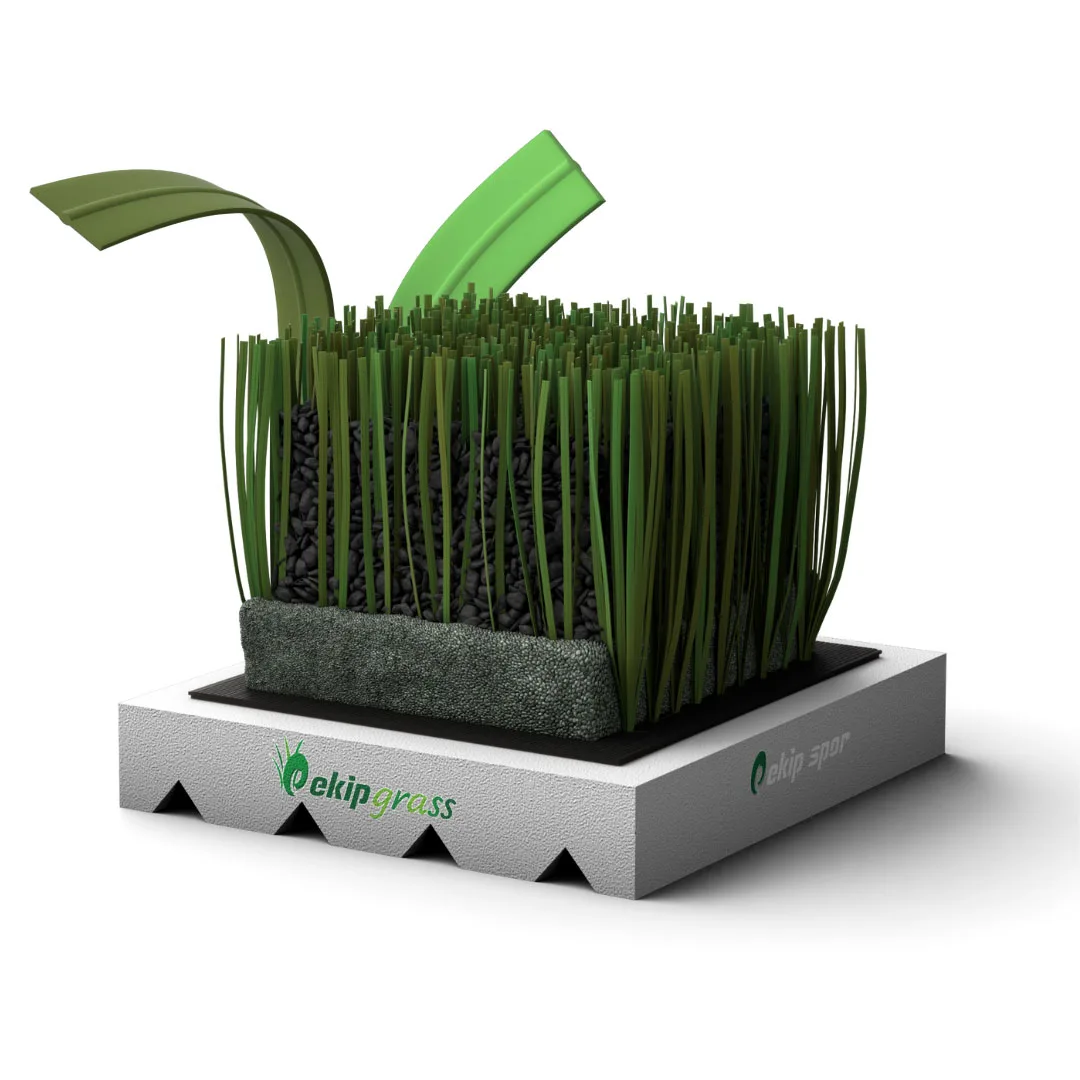
Padel turf is a short-pile carpet, often laid with a sand infill. The short pile and the sand keep the bounce even and give players a surface they can slide on slightly without losing grip. Because the ball also comes off the walls, an even bounce across the whole court, including the corners, matters as much as the feel underfoot.
Ekip Grass makes Padel Grass in 11, 13 or 15 mm pile heights; the yarn types and colours are listed on the product page. The range sits with our tennis turf in the tennis and padel turf category.
What should you plan before building a court?
- Space: the 10 m by 20 m court plus the structure, and the safety areas if out-of-court play is wanted.
- Height indoors: the FIP minimum clear height of 6 m, or 8 m suggested for new facilities, with no lights inside that space.
- Orientation outdoors: the FIP rules recommend a north to south long axis, allowing a variation between north-northeast and north-northwest.
- Base: a level, stable base that meets the 3 mm tolerance, with drainage or the permitted slope.
- Lighting: under the FIP rules, light poles stand outside the court and the lower edge of the projectors is at least 6 m above the ground.
Padel turf from Ekip Grass
Ekip Grass produces padel and tennis turf at its factory in Dilovası, Kocaeli, Türkiye. For other court surfaces see tennis court flooring, and to discuss a padel project send the court count and location through the contact page.
We also build padel courts in classic, panoramic and super panoramic types. More on padel court construction.
0 comments
Leave a comment
Your comment will be published after review.