
Summarize this article with AI Open a summary of this article in your preferred assistant
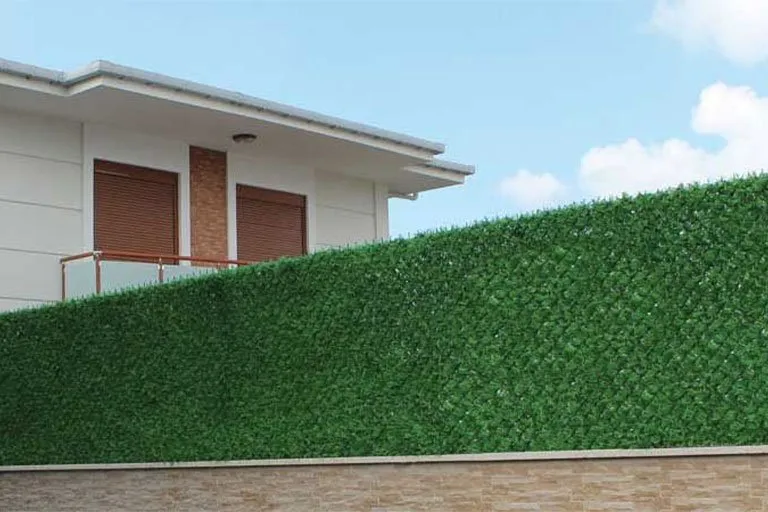
An artificial grass fence is a privacy screen made of synthetic grass, sold as rolls, slats or panels and fixed to a wire mesh, panel fence or frame. It hides the view into a garden, terrace or site without hedge care. Before buying, check the strength of the base fence and posts under wind load, UV stabilisation and the fixing method.
A grass fence is a privacy screen made of synthetic grass, sold as rolls, slats or panels and fixed to a wire mesh fence, a panel fence or a frame. It blocks the view into a garden, terrace, pool area or site and gives a green boundary without the trimming and watering a hedge needs. The screen itself carries no load, so the strength of the fence behind it decides how well the system holds up.
What types of grass fence are there?
- Roll screens: a strip of artificial grass or grass-like fibres on a mesh or fabric backing, unrolled along an existing wire fence and tied on.
- Slats for panel fences: narrow strips with a grass face that are threaded through the openings of welded mesh panels.
- Hedge panels: square or rectangular tiles of artificial leaves that clip onto a frame. These imitate a hedge rather than a lawn.
- Cut turf on a frame: rolled artificial grass, the kind used for lawns, fixed to boards or a frame. This gives the densest, most lawn-like face.
Where are grass fences used?
The most common uses are garden boundaries, balcony and terrace railings, swimming pool surrounds, café and restaurant terraces, and the perimeter of building sites or car parks where a green screen is preferred to plain hoarding. They are also used to hide bins, air conditioning units and storage areas.
How does a grass fence compare with other screens?
| Option | Privacy | Upkeep | Main limitation |
|---|---|---|---|
| Artificial grass fence | High once fixed | Occasional rinsing; check ties and fixings | Adds wind load to the existing fence |
| Natural hedge | Grows over time | Trimming, watering, feeding | Takes years to reach full height |
| Solid board or panel fence | High | Painting or staining for timber | Hard visual edge, no green look |
| Open wire mesh only | Low | Minimal | No screening |
Why does wind load matter?
A bare wire fence lets wind pass through. Once it is covered with a dense screen, it behaves more like a solid wall and the wind pushes on the whole surface. Posts, footings and fixings that were adequate for an open fence may not be adequate for a covered one.
Before covering a long or tall fence, especially in exposed coastal or hillside locations, ask the fence installer to check the post spacing and footings. Some screens are made with small gaps to let part of the wind through.
How is a grass fence installed?
- Check the base fence. Tighten loose wires, replace damaged sections and confirm that posts are firm.
- Measure. Measure the length and height to be covered and add a little extra for overlaps and trimming.
- Start at one end. Unroll or position the first section with the grass face outwards and the top edge level.
- Fix it. Use UV-resistant cable ties or the clips supplied, at regular intervals along the top, bottom and middle. Pull them tight and trim the tails.
- Join sections. Overlap the next section slightly so no gap shows, then fix it the same way.
- Finish. Trim the ends neatly and check the whole run for loose points after the first windy day.
For slat systems, the slats are threaded through the panel openings from top to bottom and locked with an end profile. Follow the manufacturer's instructions for the specific system.
What should you check before buying?
- UV stabilisation: ask whether the fibres and backing are UV stabilised, since a fence faces the sun all day.
- Density and height: a denser screen gives more privacy but adds more wind load. Check that the roll height matches the fence.
- Fixings: confirm whether ties or clips are included and whether they are UV resistant.
- Fire: the screen is made of plastics. Keep it away from barbecues and heat sources, and check local rules if it is next to a building.
- Local rules: some municipalities and housing estates limit boundary fence height or materials. Check before ordering.
Grass fence from Ekip Grass
Ekip Grass supplies grass fence screens alongside its artificial grass range. For a quote, send the length and height of the fence, the type of fence the screen will be fixed to (wire mesh, panel or frame) and the site location through the contact page. For ground-level areas next to the fence, the landscape grass range covers gardens and terraces.
Related reading
For ground-level ideas, see our artificial grass landscaping ideas, and for vertical surfaces on solid walls, our guide to artificial grass wall ideas. General care routines are in how to clean artificial grass.
Frequently asked questions
What is an artificial grass fence?
It is a privacy screen made of synthetic grass, supplied as rolls, slats or panels, that is fixed to an existing wire mesh or panel fence or to a frame. It blocks views and gives a green boundary without hedge maintenance.
Can I put a grass screen on my existing wire fence?
Usually yes, provided the posts and wires are firm. A covered fence takes more wind load than an open one, so have the posts and footings checked on long, tall or exposed runs.
How is a grass fence attached?
Roll screens are tied to the fence with UV-resistant cable ties or clips at regular intervals along the top, bottom and middle. Slat systems are threaded through mesh panels and locked with an end profile.
Does an artificial grass fence need maintenance?
It needs no watering or trimming. Rinse off dust occasionally and check the ties and fixings after strong wind.
Does Ekip Grass supply artificial grass fences?
Yes. Ekip Grass supplies artificial grass fence screens. Send the fence length, height, fence type and site location through the contact page for a quote.


0 comments
Leave a comment
Your comment will be published after review.