
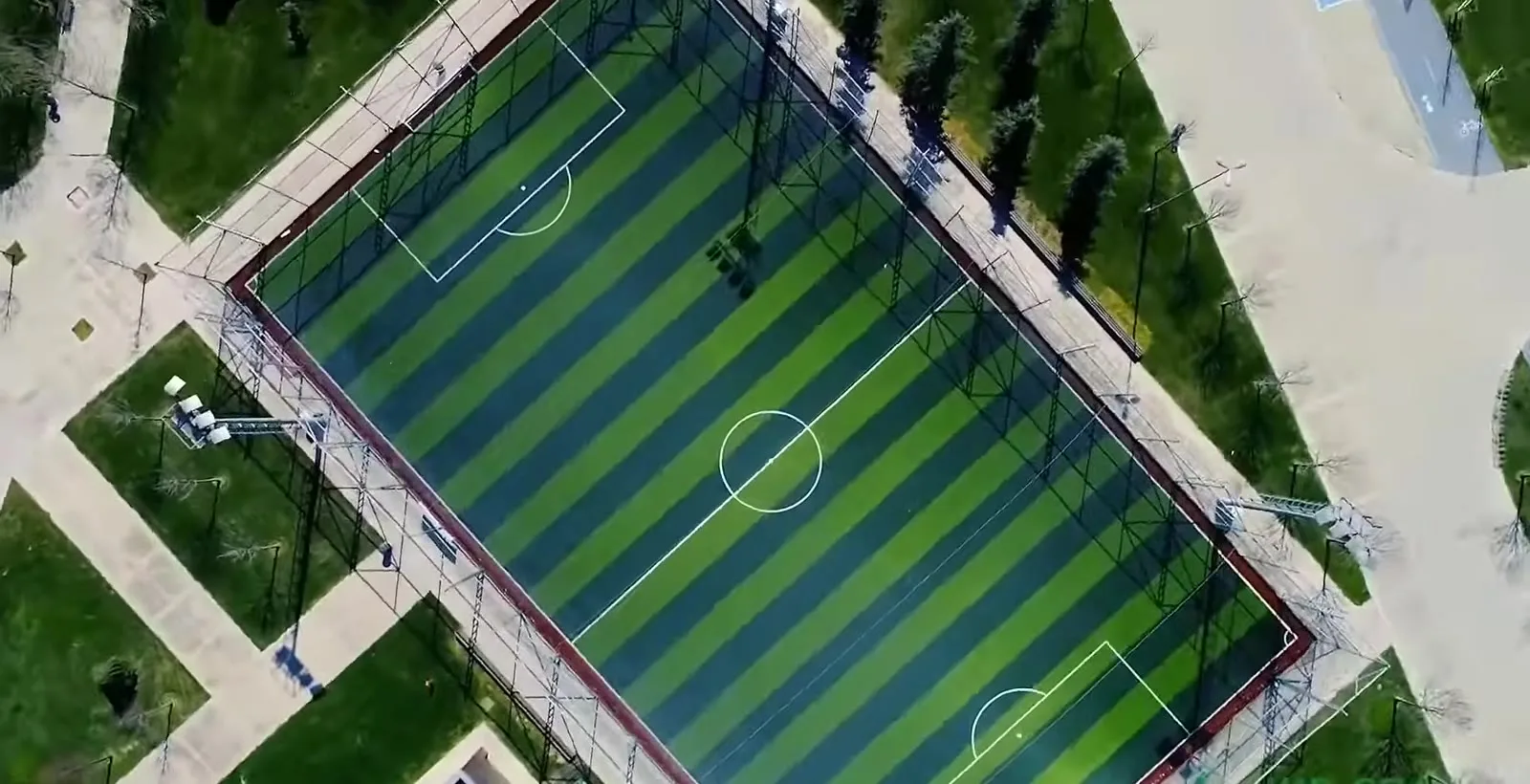
An infilled long-pile 3G build is the usual choice for a main competition pitch and FIFA currently opens FIFA Quality PRO only to filled systems. A non-infill carpet suits school, community and small-sided football and has no rubber to top up or lose, but it still needs brushing.
An infilled long-pile 3G build is the usual choice for a main competition pitch, and FIFA currently opens FIFA Quality PRO only to filled systems. A non-infill carpet such as our Non-Infill Grass, with a 30–35 mm pile and 16,000 dtex yarn, suits school, community and small-sided football and any site where rubber granules are not wanted, and it has no rubber to top up or lose. We make both kinds of turf, so this guide compares them from the carpet up.
What does infill do, and how does a non-infill carpet replace it?
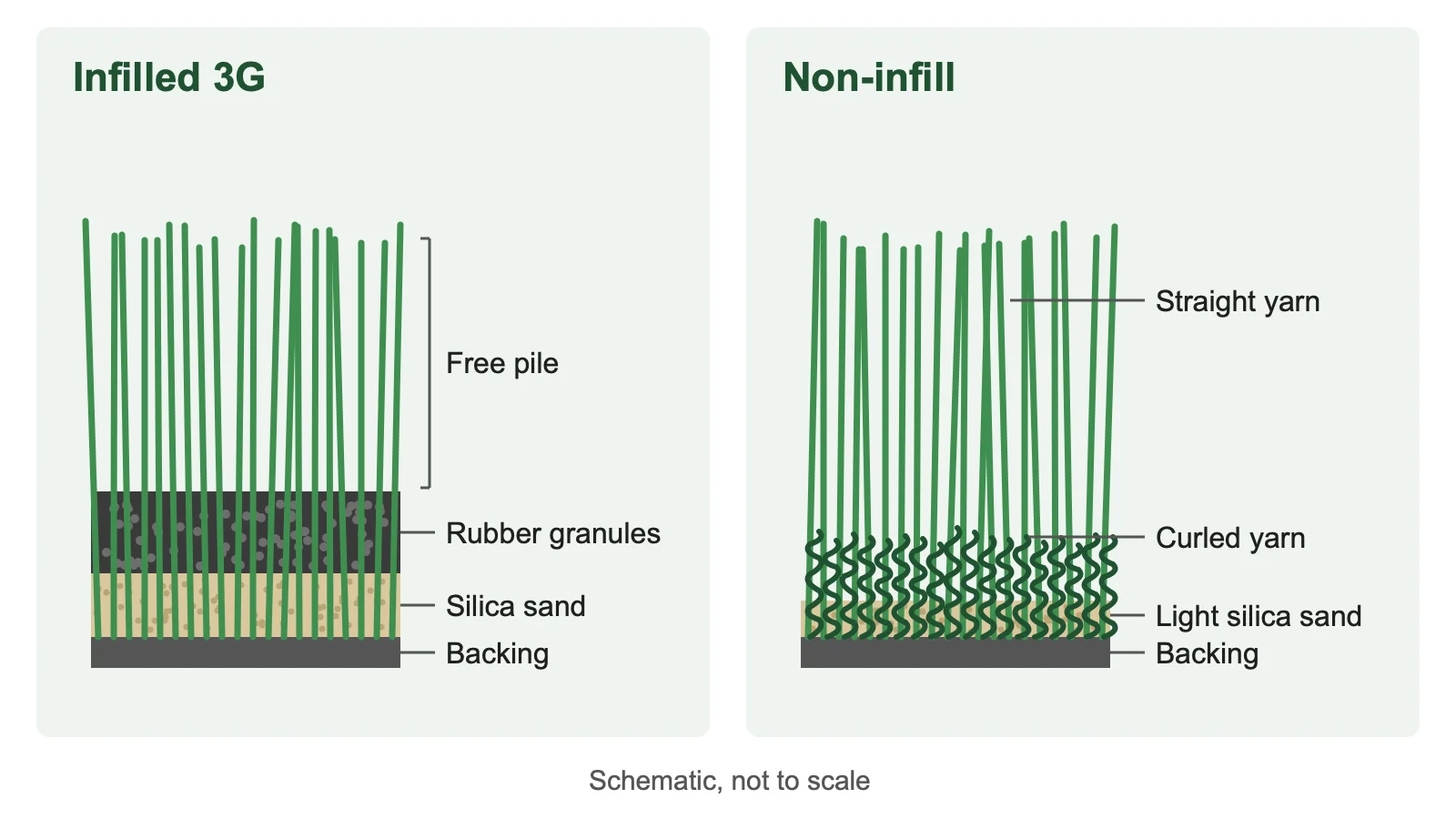
On a 3G pitch, sand holds the carpet down and a performance infill of rubber or another granule sits on top. The FA's 3G guide says performance infill supports the fibres, gives a degree of shock absorption and lets studded boots grip and slide. The materials, and the EU rule that restricts granular polymer infill on sports surfaces from 17 October 2031, are in our guide to artificial turf infill types.
A non-infill carpet holds itself up with its own yarns. We make the carpet from straight yarn together with curled yarn that fills the base of the pile, so the fibres stand without rubber granules, and we spread only a light dressing of silica sand to stabilise the carpet. The FA's guide points the same way on construction: a turf with a higher fibre density, or one that includes texturised pile, needs less infill.
For comparison, on our standard 55 mm Odin Grass football pitches we brush in 30 kg/m² of silica sand and spread 8 kg/m² of SBR granules on top. Quantities vary by carpet model.
Summarize this article with AI Open a summary of this article in your preferred assistant
Upkeep changes where the granules were
An infilled pitch has a maintenance programme built around its infill: drag brushing to keep the pile upright and the infill level, topping up in goalmouths and other high-wear areas, and periodic deep cleaning with machines that lift, sieve and return the infill. Granules also leave the pitch on boots and with water, so topping up is a recurring job.
A non-infill pitch has no rubber to top up, level or lose. Leaving the granules out removes their purchase and top-up cost and keeps the surface cleaner. Brushing and the removal of leaves and litter stay on the list, and the routine is in our guide to cleaning artificial grass.
What changes on the pitch for players
FIFA's field test for football turf measures vertical ball rebound, ball roll, shock absorption, energy return and the twisting resistance of the surface under a turning foot (Table 4 of the FIFA Quality Programme Test Manual II). On a long-pile 3G carpet the sand and rubber layers carry a large share of that work. A non-infill carpet has to deliver it through its yarn and construction alone.
Our Non-Infill Grass has a 30–35 mm pile, while we recommend 40–60 mm for football on Odin Grass. A short-pile carpet without rubber plays differently from a long-pile pitch with a cushioning layer, so match the carpet to the sport and the level of play. Compare two systems on the figures for the property you care about, such as ball roll or shock absorption, for that exact system. We send the system data sheet with every quote. Footwear follows the surface too, and our football boots guide covers it.
Does a non-infill pitch meet FIFA and league rules?
FIFA's Test Manual II sorts systems by how much infill they carry (section 4.7). A filled system has non-mineral infill above half of the pile height. A mineral-stabilised system has mineral infill, such as sand, up to a quarter of the pile height. A non-filled system has none.
Under section 4.8, only filled systems are open to FIFA Quality PRO. Systems with no infill, with mineral infill only, or with a partial non-mineral infill are eligible for FIFA Quality, and the manual says PRO eligibility for them may be considered in the future after further research. Eligibility only means a system can be tested: FIFA tests the complete system in a laboratory and then the installed pitch on site. We are a licensee of the FIFA Quality Programme for Football Turf, and the steps are on our FIFA Quality page. League rules are a separate question, and the last FAQ below gives The FA's wording as an example.
Which build suits which pitch
Most decisions come down to the level of play, what the operator can maintain, and whether rubber granules are acceptable on the site.
| Pitch situation | Build to look at first | Why |
|---|---|---|
| Main pitch for league or cup football | Infilled long-pile 3G | It is the usual route for club and full-size pitches, and competition rules may require a tested 3G pitch. |
| Pitch that needs FIFA Quality PRO | Infilled long-pile 3G | Under FIFA's Test Manual II only filled systems are open to PRO. |
| Pitch aiming for FIFA Quality | Either, if the complete system is tested | Both groups are eligible for FIFA Quality, and the testing covers the system as it is built. |
| School or community pitch for small-sided football | Non-infill | Rubber is not wanted, and brushing and debris removal are the main tasks. |
| Site where infill could reach drains or a watercourse | Non-infill | There are no granules to lose. The FA's guide has a section on managing infill loss on 3G pitches. |
| Operator without equipment or budget for infill upkeep | Non-infill | There is no top-up and no deep cleaning to lift and sieve infill. |
| Tender or funder that sets its own infill rule | Whatever the rule allows | Some leagues and public buyers set their own infill rules, so read the tender documents first. |
For schools, our school pitch guide adds pitch sizes, safety and maintenance.
Where we still specify an infilled build
When a club needs FIFA Quality PRO, plays league fixtures on a full-size pitch or wants the cushioning of a long pile, we specify an infilled system such as Odin Grass or Pro Odin Grass, with a 55–60 mm pile on Pro Odin and SBR rubber or eco infill over sand, set per project. A pitch in the EU that will be topped up after 17 October 2031 needs an infill plan that works under the rule, and the checklist in the infill guide covers it. Our football grass page shows the systems side by side.
If you are still weighing the two builds, send us the pitch size, location and timing and we will reply with a system proposal and a quote.

0 comments
Leave a comment
Your comment will be published after review.